Designing AI Driven Growth that Lasts
Designing AI Driven Growth that Lasts

The three key ingredients for producing durable value with AI.
Share
Across organizations with active AI programs, roughly 93% of investment flows into data and technology infrastructure, leaving 7% for everything else: work redesign, skills, change management, culture. This unbalanced ratio reflects an assumption about what produces durable value. Technology is the cheaper half of the problem; the expensive half is the human and organizational side, and it is this that determines the efficacy of the technology.
Reassessing this allocation is crucial for organizations aiming to drive AI driven growth that continues to compound. There are three areas where this gap between investment and outcome is most visible: trust, work redesign, and enablement.
Translating this into the commercial world, the workers who don't trust AI — 39% of them — won't use it”
“
Across organizations with active AI programs, roughly 93% of investment flows into data and technology infrastructure, leaving 7% for everything else: work redesign, skills, change management, culture. This unbalanced ratio reflects an assumption about what produces durable value. Technology is the cheaper half of the problem; the expensive half is the human and organizational side, and it is this that determines the efficacy of the technology.
Reassessing this allocation is crucial for organizations aiming to drive AI driven growth that continues to compound. There are three areas where this gap between investment and outcome is most visible: trust, work redesign, and enablement.
Translating this into the commercial world, the workers who don't trust AI — 39% of them — won't use it”
“
Across organizations with active AI programs, roughly 93% of investment flows into data and technology infrastructure, leaving 7% for everything else: work redesign, skills, change management, culture. This unbalanced ratio reflects an assumption about what produces durable value. Technology is the cheaper half of the problem; the expensive half is the human and organizational side, and it is this that determines the efficacy of the technology.
Reassessing this allocation is crucial for organizations aiming to drive AI driven growth that continues to compound. There are three areas where this gap between investment and outcome is most visible: trust, work redesign, and enablement.
“Translating this into the commercial world, the workers who don't trust AI — 39% of them — won't use it”
Fixing trust
Trust is perhaps the most important one. Interestingly, since the start of 2025, individual AI usage has declined by approximately 8%. There are several possible explanations for this. The previous year was a hype peak, and people were experimenting widely. The public discourse has become polarized, with university student trust in AI dropping over 13%. Moreover, there is a broader cultural reaction to the pace and direction of the technology.
Translating this into the commercial world, the workers who do not trust AI — 39% of them — will not use it, regardless of how much an organization has spent on the underlying capability.
Trust can be broken down into four dimensions: humanity, transparency, capability, and reliability. Organizations failing on trust are usually failing on one of these specifically, and the appropriate intervention differs depending on which one it is.
Take the example of a consumer products company who prepared to scale an AI sales assistant across its organization. A trust assessment revealed strong transparency and relationship dimensions, but a weak capability dimension, because the team was not confident the tool did what it claimed. Instead of scaling, the organization redirected budget back into the product roadmap to close the capability gap before rollout.
The inverse occurred in another case: a high-quality internal AI tool was adopted by around 18% of intended employees. In this case, the capability was clear, but the transparency was not. Employees could not tell where the tool's answers came from and therefore did not feel confident in using it. Correspondingly, the fix here was to invest in communication around the tool: explaining what it did under the hood and sharing success stories.
Fixing trust
Trust is perhaps the most important one. Interestingly, since the start of 2025, individual AI usage has declined by approximately 8%. There are several possible explanations for this. The previous year was a hype peak, and people were experimenting widely. The public discourse has become polarized, with university student trust in AI dropping over 13%. Moreover, there is a broader cultural reaction to the pace and direction of the technology.
Translating this into the commercial world, the workers who do not trust AI — 39% of them — will not use it, regardless of how much an organization has spent on the underlying capability.
Trust can be broken down into four dimensions: humanity, transparency, capability, and reliability. Organizations failing on trust are usually failing on one of these specifically, and the appropriate intervention differs depending on which one it is.
Take the example of a consumer products company who prepared to scale an AI sales assistant across its organization. A trust assessment revealed strong transparency and relationship dimensions, but a weak capability dimension, because the team was not confident the tool did what it claimed. Instead of scaling, the organization redirected budget back into the product roadmap to close the capability gap before rollout.
The inverse occurred in another case: a high-quality internal AI tool was adopted by around 18% of intended employees. In this case, the capability was clear, but the transparency was not. Employees could not tell where the tool's answers came from and therefore did not feel confident in using it. Correspondingly, the fix here was to invest in communication around the tool: explaining what it did under the hood and sharing success stories.
Fixing trust
Trust is perhaps the most important one. Interestingly, since the start of 2025, individual AI usage has declined by approximately 8%. There are several possible explanations for this. The previous year was a hype peak, and people were experimenting widely. The public discourse has become polarized, with university student trust in AI dropping over 13%. Moreover, there is a broader cultural reaction to the pace and direction of the technology.
Translating this into the commercial world, the workers who do not trust AI — 39% of them — will not use it, regardless of how much an organization has spent on the underlying capability.
Trust can be broken down into four dimensions: humanity, transparency, capability, and reliability. Organizations failing on trust are usually failing on one of these specifically, and the appropriate intervention differs depending on which one it is.
Take the example of a consumer products company who prepared to scale an AI sales assistant across its organization. A trust assessment revealed strong transparency and relationship dimensions, but a weak capability dimension, because the team was not confident the tool did what it claimed. Instead of scaling, the organization redirected budget back into the product roadmap to close the capability gap before rollout.
The inverse occurred in another case: a high-quality internal AI tool was adopted by around 18% of intended employees. In this case, the capability was clear, but the transparency was not. Employees could not tell where the tool's answers came from and therefore did not feel confident in using it. Correspondingly, the fix here was to invest in communication around the tool: explaining what it did under the hood and sharing success stories.
Redesigning rather than adapting
Work redesign is the second crucial element for driving growth with AI. The question of 'how can I improve this process?' approaches AI use from the wrong perspective. Instead, try asking 'what are we trying to do here, and how should it be designed from scratch with humans and machines in mind?'. Thinking backwards from intended outcomes, rather than trying to build from existing processes and systems is crucial.
84% of organizations investing in AI do not do this. They have taken no steps to redesign the work itself. Instead, they have bought the tools and assumed that productivity gains will follow as a consequence.
For example, a software company outsourced a particularly technical and variable workflow. Costs rose as the customer base grew and the AI tools given to the outsourced team were failing to produce visible change. The fix was a full workflow redesign, which involved moving some of the work upstream to product, where it belonged, and rebuilding the remaining work around what AI could now do alongside humans. Within weeks of the redesigned process going live, cycle times shortened and CSAT scores rose.
The skills required for AI work have also changed noticeably.”
“
Redesigning rather than adapting
Work redesign is the second crucial element for driving growth with AI. The question of 'how can I improve this process?' approaches AI use from the wrong perspective. Instead, try asking 'what are we trying to do here, and how should it be designed from scratch with humans and machines in mind?'. Thinking backwards from intended outcomes, rather than trying to build from existing processes and systems is crucial.
84% of organizations investing in AI do not do this. They have taken no steps to redesign the work itself. Instead, they have bought the tools and assumed that productivity gains will follow as a consequence.
For example, a software company outsourced a particularly technical and variable workflow. Costs rose as the customer base grew and the AI tools given to the outsourced team were failing to produce visible change. The fix was a full workflow redesign, which involved moving some of the work upstream to product, where it belonged, and rebuilding the remaining work around what AI could now do alongside humans. Within weeks of the redesigned process going live, cycle times shortened and CSAT scores rose.
The skills required for AI work have also changed noticeably.”
“
Redesigning rather than adapting
Work redesign is the second crucial element for driving growth with AI. The question of 'how can I improve this process?' approaches AI use from the wrong perspective. Instead, try asking 'what are we trying to do here, and how should it be designed from scratch with humans and machines in mind?'. Thinking backwards from intended outcomes, rather than trying to build from existing processes and systems is crucial.
84% of organizations investing in AI do not do this. They have taken no steps to redesign the work itself. Instead, they have bought the tools and assumed that productivity gains will follow as a consequence.
For example, a software company outsourced a particularly technical and variable workflow. Costs rose as the customer base grew and the AI tools given to the outsourced team were failing to produce visible change. The fix was a full workflow redesign, which involved moving some of the work upstream to product, where it belonged, and rebuilding the remaining work around what AI could now do alongside humans. Within weeks of the redesigned process going live, cycle times shortened and CSAT scores rose.
“The skills required for AI work have also changed noticeably.”
Time to learn
The third area is the structural challenge most familiar to operating leaders: people have to do their jobs and transform them simultaneously.
One of the most consistent drivers of failed AI rollouts is that employees simply do not have the time they need to learn to become fluent in AI, however that looks in their specific role. The organizations that succeed at AI adoption are those that allocate time towards learning — not as an after-hours commitment, but as a core part of the role.
This can be exacerbated by leadership talking about AI while not actually using it themselves. These leaders do not develop the intuition and practical knowledge required to make decisions about rolling out AI; to them, AI is abstract.
The skills required for AI work have also changed noticeably. A year ago, the most common request from customer success professionals was about training customers on prompting. In contrast, recent requests are about how to use AI responsibly, how to work with the data behind AI-driven decisions, and how to manage the economics of AI usage at scale.
Time to learn
The third area is the structural challenge most familiar to operating leaders: people have to do their jobs and transform them simultaneously.
One of the most consistent drivers of failed AI rollouts is that employees simply do not have the time they need to learn to become fluent in AI, however that looks in their specific role. The organizations that succeed at AI adoption are those that allocate time towards learning — not as an after-hours commitment, but as a core part of the role.
This can be exacerbated by leadership talking about AI while not actually using it themselves. These leaders do not develop the intuition and practical knowledge required to make decisions about rolling out AI; to them, AI is abstract.
The skills required for AI work have also changed noticeably. A year ago, the most common request from customer success professionals was about training customers on prompting. In contrast, recent requests are about how to use AI responsibly, how to work with the data behind AI-driven decisions, and how to manage the economics of AI usage at scale.
Time to learn
The third area is the structural challenge most familiar to operating leaders: people have to do their jobs and transform them simultaneously.
One of the most consistent drivers of failed AI rollouts is that employees simply do not have the time they need to learn to become fluent in AI, however that looks in their specific role. The organizations that succeed at AI adoption are those that allocate time towards learning — not as an after-hours commitment, but as a core part of the role.
This can be exacerbated by leadership talking about AI while not actually using it themselves. These leaders do not develop the intuition and practical knowledge required to make decisions about rolling out AI; to them, AI is abstract.
The skills required for AI work have also changed noticeably. A year ago, the most common request from customer success professionals was about training customers on prompting. In contrast, recent requests are about how to use AI responsibly, how to work with the data behind AI-driven decisions, and how to manage the economics of AI usage at scale.
Where to begin
Designing AI-driven growth that lasts is work that almost nobody is funding adequately. For leaders considering where to start, the most useful move is a modest one.
Pick one issue and start there. It could be a trust breakdown blocking adoption, a skills gap that has been ignored, or a workflow that needs redesigning before any tool is applied to it.
The organizations that succeed at AI over the next few years will not necessarily be the ones with the largest AI budgets. They will be the ones that took the 7% seriously.
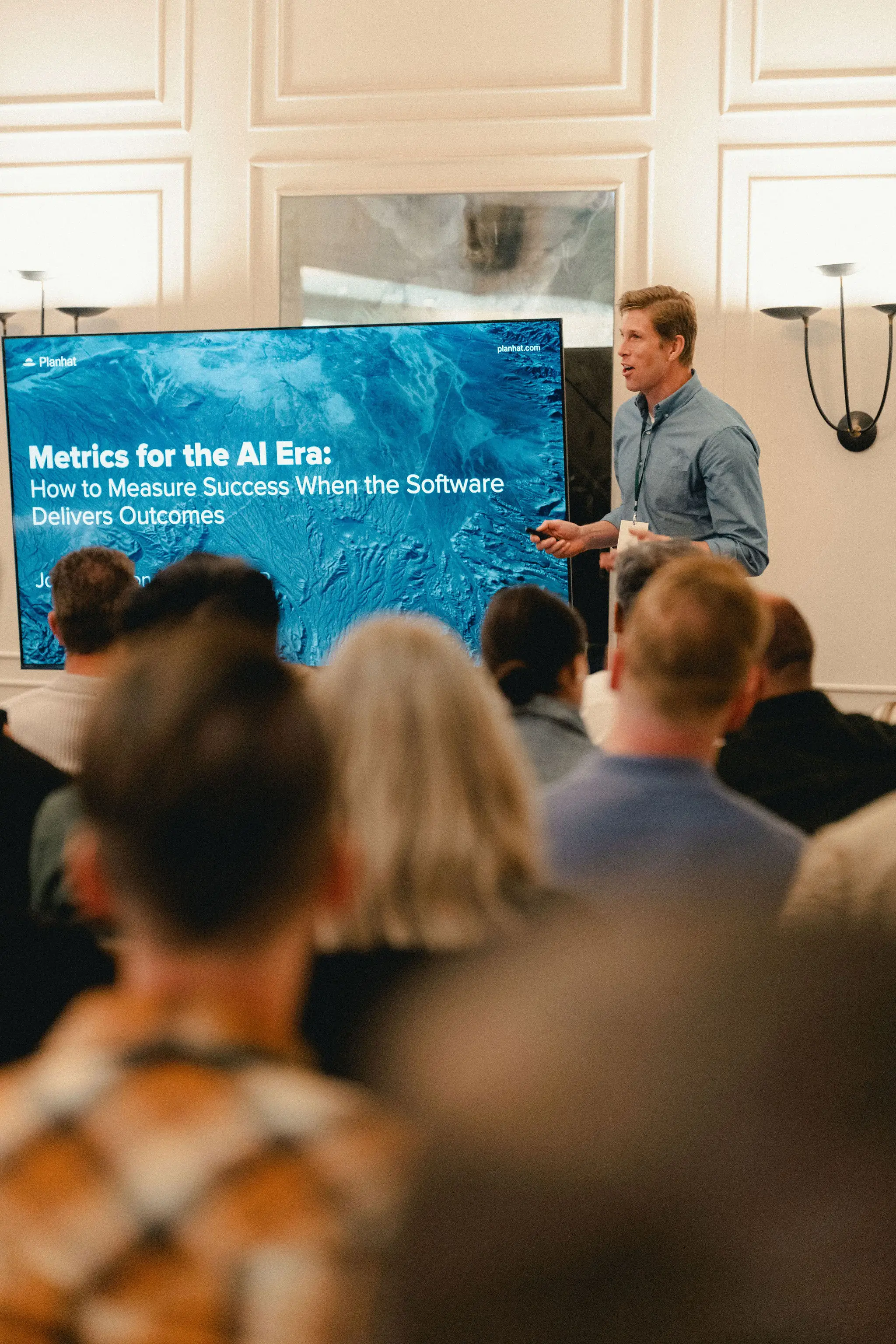
This article is based on a talk given at Planhat Open 2026. Certain sections have been modified for editorial clarity.
Where to begin
Designing AI-driven growth that lasts is work that almost nobody is funding adequately. For leaders considering where to start, the most useful move is a modest one.
Pick one issue and start there. It could be a trust breakdown blocking adoption, a skills gap that has been ignored, or a workflow that needs redesigning before any tool is applied to it.
The organizations that succeed at AI over the next few years will not necessarily be the ones with the largest AI budgets. They will be the ones that took the 7% seriously.
This article is based on a talk given at Planhat Open 2026. Certain sections have been modified for editorial clarity.
Where to begin
Designing AI-driven growth that lasts is work that almost nobody is funding adequately. For leaders considering where to start, the most useful move is a modest one.
Pick one issue and start there. It could be a trust breakdown blocking adoption, a skills gap that has been ignored, or a workflow that needs redesigning before any tool is applied to it.
The organizations that succeed at AI over the next few years will not necessarily be the ones with the largest AI budgets. They will be the ones that took the 7% seriously.
This article is based on a talk given at Planhat Open 2026. Certain sections have been modified for editorial clarity.
Expert Advice
Discover best practices from veterans of industry.
[
Discover All
]
[
Through the Lens
]
[
Talking Planhat
]
[
Expert Advice
]
[
In Perspective
]
[
In Conversation
]





Load more
Expert Advice
Discover best practices from veterans of industry.
[
Discover All
]
[
Through the Lens
]
[
Talking Planhat
]
[
Expert Advice
]
[
In Perspective
]
[
In Conversation
]
Load more
Expert Advice
Discover best practices from veterans of industry.
[
Discover All
]
[
Through the Lens
]
[
Talking Planhat
]
[
Expert Advice
]
[
In Perspective
]
[
In Conversation
]
Load more

Don't miss a beat.
Don't miss a beat.