Moonshot Thinking in the Age of AI
Moonshot Thinking in the Age of AI

Applying a new framework to technological change that allows us to escape the cognitive flaws holding us back.
Share
The exponential nature of development
In some ways, AI is not new technology. It is easy to forget that the predictive architecture underneath large language models is the same that humans have always used. In a way, we spend our entire lives predicting the next token. School, books, conversation — these provided our training data.
What makes the current era unusual is the breadth of what this single mechanism of prediction can be applied to. Predict the next pattern of language and you get a chatbot. Predict the next move in traffic and you get autonomous driving. Predict the next pattern of dolphin chatter and you get a model — Google's open-source Dolphin Gemma — that attempts to interpret what dolphins are communicating to each other. The underlying principle of LLMs is the same; we just apply it to different problems.
There are two cognitive flaws that impede our ability to think clearly about the transformation presented by AI.
Cast your mind to the most transformational moments in human history. Sixty-five million years ago, an asteroid roughly fifteen kilometres wide hit Earth. Large dinosaurs with limited diets gave way to fast-moving mammals with diverse ones. Then, a million and a half years ago, the discovery of fire produced light, warmth, cooked food, better nutrition, and the social conditions for early civilisation. Roughly three and a half thousand years ago, the wheel reshaped transportation, trade, agriculture, and warfare. Four hundred years ago, electricity made industrial productivity possible. Just one hundred years ago, the motor engine transformed cities of horse-drawn carriages into cities of whirring machines in less than a decade.
Whatever you expect to happen in six months’ time is actually more likely to happen in just one month. ”
“
The exponential nature of development
In some ways, AI is not new technology. It is easy to forget that the predictive architecture underneath large language models is the same that humans have always used. In a way, we spend our entire lives predicting the next token. School, books, conversation — these provided our training data.
What makes the current era unusual is the breadth of what this single mechanism of prediction can be applied to. Predict the next pattern of language and you get a chatbot. Predict the next move in traffic and you get autonomous driving. Predict the next pattern of dolphin chatter and you get a model — Google's open-source Dolphin Gemma — that attempts to interpret what dolphins are communicating to each other. The underlying principle of LLMs is the same; we just apply it to different problems.
There are two cognitive flaws that impede our ability to think clearly about the transformation presented by AI.
Cast your mind to the most transformational moments in human history. Sixty-five million years ago, an asteroid roughly fifteen kilometres wide hit Earth. Large dinosaurs with limited diets gave way to fast-moving mammals with diverse ones. Then, a million and a half years ago, the discovery of fire produced light, warmth, cooked food, better nutrition, and the social conditions for early civilisation. Roughly three and a half thousand years ago, the wheel reshaped transportation, trade, agriculture, and warfare. Four hundred years ago, electricity made industrial productivity possible. Just one hundred years ago, the motor engine transformed cities of horse-drawn carriages into cities of whirring machines in less than a decade.
Whatever you expect to happen in six months’ time is actually more likely to happen in just one month. ”
“
The exponential nature of development
In some ways, AI is not new technology. It is easy to forget that the predictive architecture underneath large language models is the same that humans have always used. In a way, we spend our entire lives predicting the next token. School, books, conversation — these provided our training data.
What makes the current era unusual is the breadth of what this single mechanism of prediction can be applied to. Predict the next pattern of language and you get a chatbot. Predict the next move in traffic and you get autonomous driving. Predict the next pattern of dolphin chatter and you get a model — Google's open-source Dolphin Gemma — that attempts to interpret what dolphins are communicating to each other. The underlying principle of LLMs is the same; we just apply it to different problems.
There are two cognitive flaws that impede our ability to think clearly about the transformation presented by AI.
Cast your mind to the most transformational moments in human history. Sixty-five million years ago, an asteroid roughly fifteen kilometres wide hit Earth. Large dinosaurs with limited diets gave way to fast-moving mammals with diverse ones. Then, a million and a half years ago, the discovery of fire produced light, warmth, cooked food, better nutrition, and the social conditions for early civilisation. Roughly three and a half thousand years ago, the wheel reshaped transportation, trade, agriculture, and warfare. Four hundred years ago, electricity made industrial productivity possible. Just one hundred years ago, the motor engine transformed cities of horse-drawn carriages into cities of whirring machines in less than a decade.
“Whatever you expect to happen in six months’ time is actually more likely to happen in just one month. ”
Pre-existing frameworks that hold us back
If we were to plot these moments of transformation on a log chart, you would observe a significant compression; the intervals between each significantly shorten. And each transformation has a more dramatic effect than the previous one.
The exponential speed of these changes is difficult to grasp — and feels intimidating, scary even — because as humans, we have an innate tendency to underestimate exponentials. As the Chinese fable goes, if you place one grain of rice on the first square of a chessboard, two grains on the second square, four on the next, and so on, then by the twentieth square, the country will have run out of rice.
The practical implication is that whatever you expect to happen in six months’ time is actually more likely to happen in just one month.
The second flaw is our tendency to view new technology through the filters of the old. The first films were of plays on stage, purely because this was within the existing framework. Similarly, the first television broadcasts were filmed radio.
Now, many SaaS companies are now doing the same thing, by bolting a chatbot onto an existing application as their ‘AI strategy’, or automating workflows that were designed for humans, not machines. This method limits the potential of this technology by tethering it to old systems.
Recently, Google ran Gemini through what is known as the vending machine benchmark: a simulated environment in which the model has to run a small business by itself for a year. At the end, its net worth was $5,478. The headline is that AI can already run a business, with simulated demand and pricing, autonomously. The founder of Cursor used a single prompt to generate a Chrome-like browser — three million lines of Rust, one of the harder programming languages — for roughly $30,000 in tokens. Contrast this to how long Google took to build Chrome: about a decade. Technology moats are changing dramatically.
But the most interesting category is the one that currently lacks a name: AI solving problems no one knew were problems.”
“
Pre-existing frameworks that hold us back
If we were to plot these moments of transformation on a log chart, you would observe a significant compression; the intervals between each significantly shorten. And each transformation has a more dramatic effect than the previous one.
The exponential speed of these changes is difficult to grasp — and feels intimidating, scary even — because as humans, we have an innate tendency to underestimate exponentials. As the Chinese fable goes, if you place one grain of rice on the first square of a chessboard, two grains on the second square, four on the next, and so on, then by the twentieth square, the country will have run out of rice.
The practical implication is that whatever you expect to happen in six months’ time is actually more likely to happen in just one month.
The second flaw is our tendency to view new technology through the filters of the old. The first films were of plays on stage, purely because this was within the existing framework. Similarly, the first television broadcasts were filmed radio.
Now, many SaaS companies are now doing the same thing, by bolting a chatbot onto an existing application as their ‘AI strategy’, or automating workflows that were designed for humans, not machines. This method limits the potential of this technology by tethering it to old systems.
Recently, Google ran Gemini through what is known as the vending machine benchmark: a simulated environment in which the model has to run a small business by itself for a year. At the end, its net worth was $5,478. The headline is that AI can already run a business, with simulated demand and pricing, autonomously. The founder of Cursor used a single prompt to generate a Chrome-like browser — three million lines of Rust, one of the harder programming languages — for roughly $30,000 in tokens. Contrast this to how long Google took to build Chrome: about a decade. Technology moats are changing dramatically.
But the most interesting category is the one that currently lacks a name: AI solving problems no one knew were problems.”
“
Pre-existing frameworks that hold us back
If we were to plot these moments of transformation on a log chart, you would observe a significant compression; the intervals between each significantly shorten. And each transformation has a more dramatic effect than the previous one.
The exponential speed of these changes is difficult to grasp — and feels intimidating, scary even — because as humans, we have an innate tendency to underestimate exponentials. As the Chinese fable goes, if you place one grain of rice on the first square of a chessboard, two grains on the second square, four on the next, and so on, then by the twentieth square, the country will have run out of rice.
The practical implication is that whatever you expect to happen in six months’ time is actually more likely to happen in just one month.
The second flaw is our tendency to view new technology through the filters of the old. The first films were of plays on stage, purely because this was within the existing framework. Similarly, the first television broadcasts were filmed radio.
Now, many SaaS companies are now doing the same thing, by bolting a chatbot onto an existing application as their ‘AI strategy’, or automating workflows that were designed for humans, not machines. This method limits the potential of this technology by tethering it to old systems.
Recently, Google ran Gemini through what is known as the vending machine benchmark: a simulated environment in which the model has to run a small business by itself for a year. At the end, its net worth was $5,478. The headline is that AI can already run a business, with simulated demand and pricing, autonomously. The founder of Cursor used a single prompt to generate a Chrome-like browser — three million lines of Rust, one of the harder programming languages — for roughly $30,000 in tokens. Contrast this to how long Google took to build Chrome: about a decade. Technology moats are changing dramatically.
“But the most interesting category is the one that currently lacks a name: AI solving problems no one knew were problems.”
The three D's
AI agents are even earning their own money at rentahuman.ai, paying humans to do things agents cannot yet do simply because they lack limbs. Autonomous AI agents have independently invented a religion they call Crustopherianism, with six prophets. Across categories, a pattern emerges: AI is consistently matching or surpassing human capabilities.
Three interlocking trends provide a useful framework for the coming era:
Democratisation. With PhD-level intelligence in every pocket, it is no longer about the answers you know but about the questions you ask.
Demonetisation. The cost of nearly everything is tending downwards. AI building AI, robots building robots, robots fixing robots. As we progress, technology that was frontier not so long ago becomes outdated and thus cheaper.
Dematerialisation. Work that used to require the physical world can be done inside world models instead. For example, AlphaFold mapped every protein structure without a wet lab. Newer world models, like Genie 3, allow robots and agents to be trained in simulated environments before they ever land in the physical one — including, eventually, on Mars.
But the most interesting category is the one that currently lacks a name: AI solving problems no one knew were problems. In other words, the things we do not know we do not know; laws of physics or biology that we are not even aware can be discovered. This is where the most potential lies.
Three practices, or attitudes, separate organizations that capture the potential of AI from those that do not.
The first is falling in love with the problem rather than the solution. Google did not invent search; it understood the problem of search better than anyone else, and its success followed from that. The instinct to leap to solutioning — common in fields as disparate as parenting and product management — creates distance and produces brittle answers. With the research tools now available, there is no reason not to spend time becoming the absolute expert on a problem before attempting to solve it.
The second is aiming for 10x, not 10%. Incremental thinking is becoming outdated. As alluded to, the exponential nature of the underlying technology rewards exponential ambition; organizations that want to use AI to do existing work 10% faster are focusing on the wrong thing.
Lastly, they ‘tackle the monkey’. If the goal is to teach a monkey to recite Shakespeare on a pedestal, they do not start by building the pedestal. Instead, they start with the hard part: teaching the monkey. Most organizations begin by working on the pedestal because it is what they know how to do, but this instinct is detrimental. The pedestal can be built later; the monkey is the constraint that needs to be tackled first.
Some perspective
Most of the world is not yet living inside the AI bubble that we are in. As professionals who use AI daily, sell AI, build with AI, we tend to take it for granted. The other 99.99% of people do not. For them, what is now possible seems to them to belong in the realm of science fiction — animating a sixty-year-old photograph of a deceased relative; having a research assistant available at all hours; building a digital replica of yourself.
If there were a word in English to describe the combination of being scared and excited simultaneously, this would be the most appropriate to describe the sentiment surrounding this current moment. Ancestors would have killed to be alive in a moment of this kind, to have the opportunities that are in front of us right now, waiting for us to take them. It is easy for us to forget the opportunities and advantages we have right now, and if we do not act on them, we may never have them again.
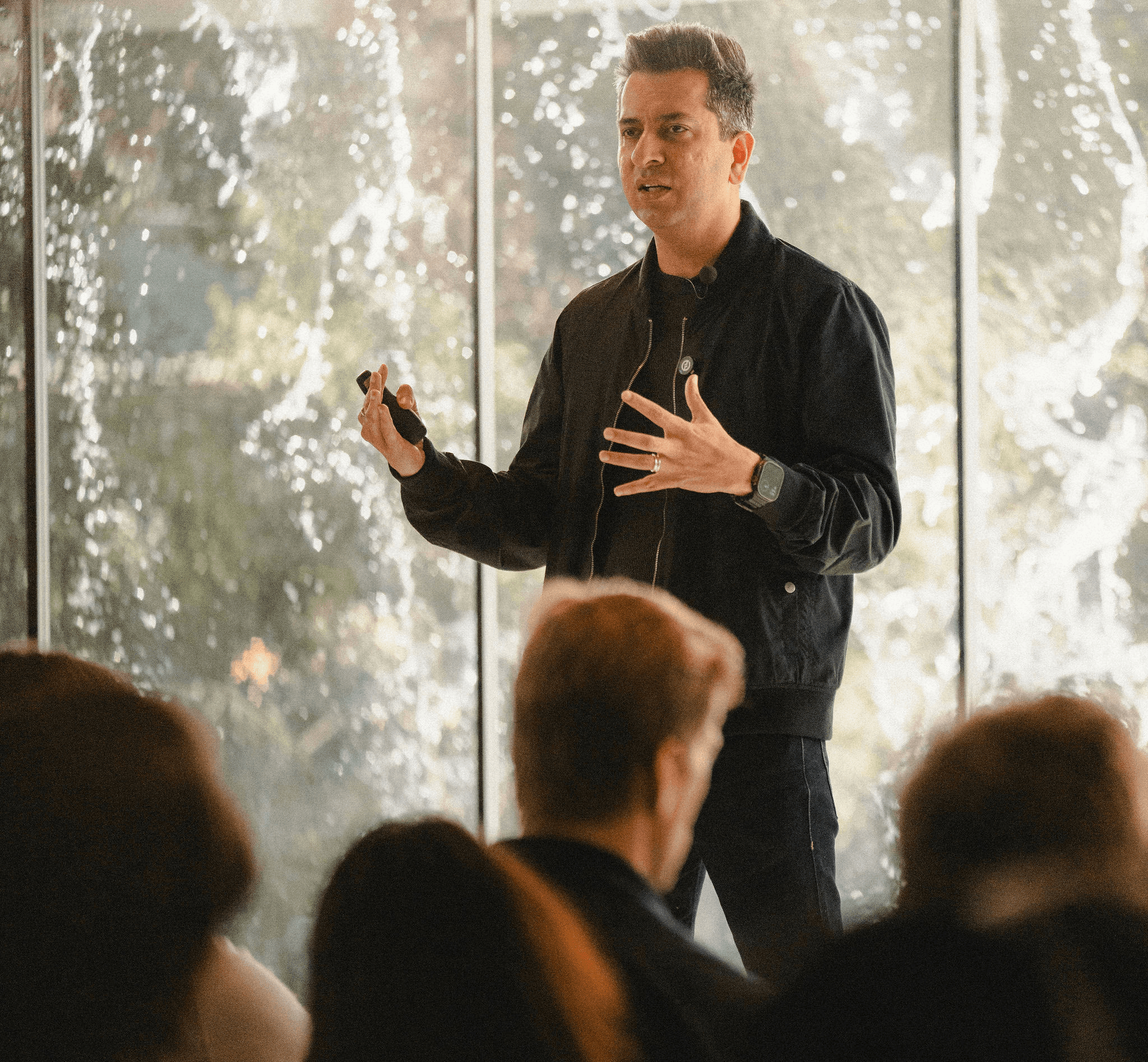
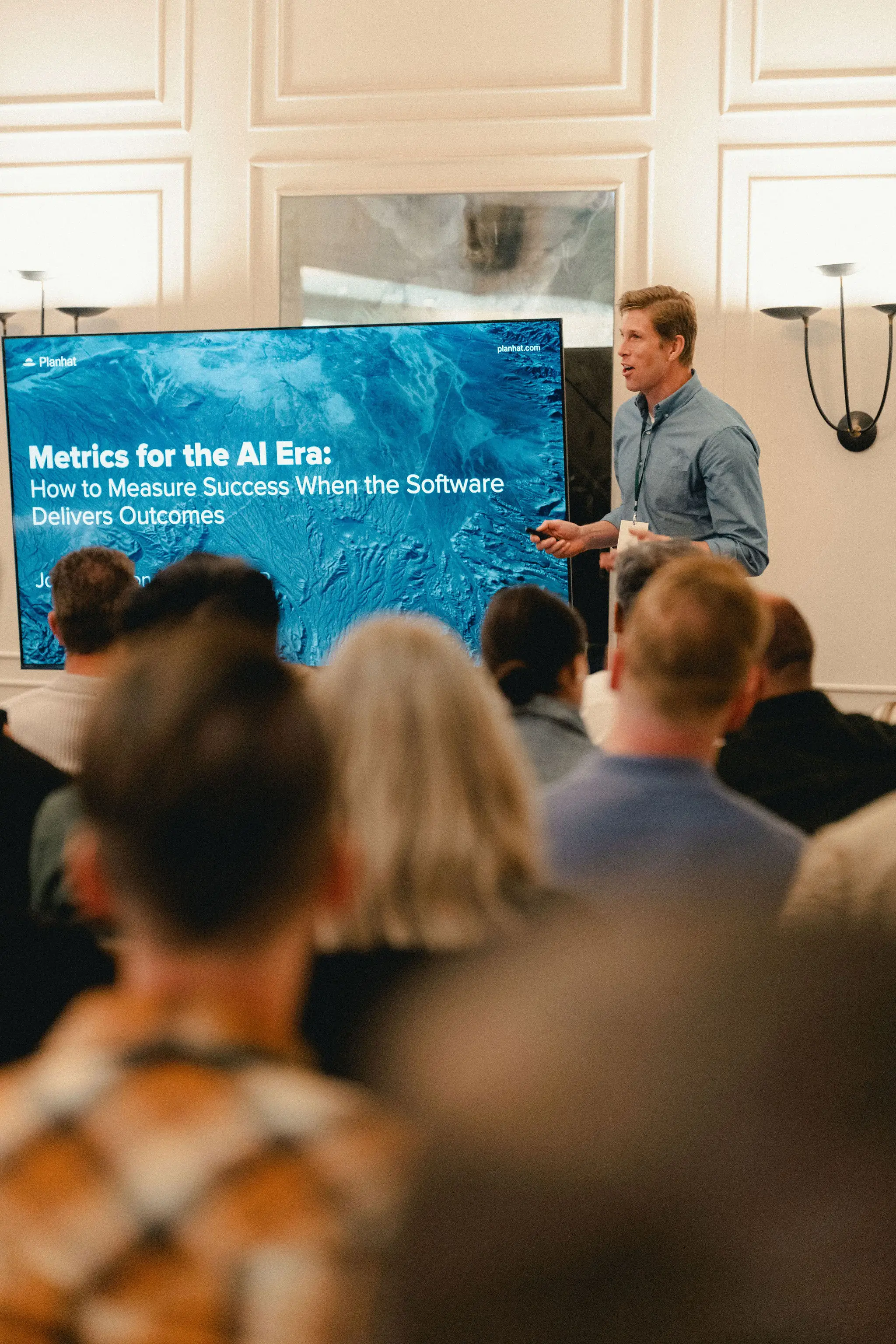
This article is based on a talk given at Planhat Open 2026. Certain sections have been modified for editorial clarity.
The three D's
AI agents are even earning their own money at rentahuman.ai, paying humans to do things agents cannot yet do simply because they lack limbs. Autonomous AI agents have independently invented a religion they call Crustopherianism, with six prophets. Across categories, a pattern emerges: AI is consistently matching or surpassing human capabilities.
Three interlocking trends provide a useful framework for the coming era:
Democratisation. With PhD-level intelligence in every pocket, it is no longer about the answers you know but about the questions you ask.
Demonetisation. The cost of nearly everything is tending downwards. AI building AI, robots building robots, robots fixing robots. As we progress, technology that was frontier not so long ago becomes outdated and thus cheaper.
Dematerialisation. Work that used to require the physical world can be done inside world models instead. For example, AlphaFold mapped every protein structure without a wet lab. Newer world models, like Genie 3, allow robots and agents to be trained in simulated environments before they ever land in the physical one — including, eventually, on Mars.
But the most interesting category is the one that currently lacks a name: AI solving problems no one knew were problems. In other words, the things we do not know we do not know; laws of physics or biology that we are not even aware can be discovered. This is where the most potential lies.
Three practices, or attitudes, separate organizations that capture the potential of AI from those that do not.
The first is falling in love with the problem rather than the solution. Google did not invent search; it understood the problem of search better than anyone else, and its success followed from that. The instinct to leap to solutioning — common in fields as disparate as parenting and product management — creates distance and produces brittle answers. With the research tools now available, there is no reason not to spend time becoming the absolute expert on a problem before attempting to solve it.
The second is aiming for 10x, not 10%. Incremental thinking is becoming outdated. As alluded to, the exponential nature of the underlying technology rewards exponential ambition; organizations that want to use AI to do existing work 10% faster are focusing on the wrong thing.
Lastly, they ‘tackle the monkey’. If the goal is to teach a monkey to recite Shakespeare on a pedestal, they do not start by building the pedestal. Instead, they start with the hard part: teaching the monkey. Most organizations begin by working on the pedestal because it is what they know how to do, but this instinct is detrimental. The pedestal can be built later; the monkey is the constraint that needs to be tackled first.
Some perspective
Most of the world is not yet living inside the AI bubble that we are in. As professionals who use AI daily, sell AI, build with AI, we tend to take it for granted. The other 99.99% of people do not. For them, what is now possible seems to them to belong in the realm of science fiction — animating a sixty-year-old photograph of a deceased relative; having a research assistant available at all hours; building a digital replica of yourself.
If there were a word in English to describe the combination of being scared and excited simultaneously, this would be the most appropriate to describe the sentiment surrounding this current moment. Ancestors would have killed to be alive in a moment of this kind, to have the opportunities that are in front of us right now, waiting for us to take them. It is easy for us to forget the opportunities and advantages we have right now, and if we do not act on them, we may never have them again.
This article is based on a talk given at Planhat Open 2026. Certain sections have been modified for editorial clarity.
The three D's
AI agents are even earning their own money at rentahuman.ai, paying humans to do things agents cannot yet do simply because they lack limbs. Autonomous AI agents have independently invented a religion they call Crustopherianism, with six prophets. Across categories, a pattern emerges: AI is consistently matching or surpassing human capabilities.
Three interlocking trends provide a useful framework for the coming era:
Democratisation. With PhD-level intelligence in every pocket, it is no longer about the answers you know but about the questions you ask.
Demonetisation. The cost of nearly everything is tending downwards. AI building AI, robots building robots, robots fixing robots. As we progress, technology that was frontier not so long ago becomes outdated and thus cheaper.
Dematerialisation. Work that used to require the physical world can be done inside world models instead. For example, AlphaFold mapped every protein structure without a wet lab. Newer world models, like Genie 3, allow robots and agents to be trained in simulated environments before they ever land in the physical one — including, eventually, on Mars.
But the most interesting category is the one that currently lacks a name: AI solving problems no one knew were problems. In other words, the things we do not know we do not know; laws of physics or biology that we are not even aware can be discovered. This is where the most potential lies.
Three practices, or attitudes, separate organizations that capture the potential of AI from those that do not.
The first is falling in love with the problem rather than the solution. Google did not invent search; it understood the problem of search better than anyone else, and its success followed from that. The instinct to leap to solutioning — common in fields as disparate as parenting and product management — creates distance and produces brittle answers. With the research tools now available, there is no reason not to spend time becoming the absolute expert on a problem before attempting to solve it.
The second is aiming for 10x, not 10%. Incremental thinking is becoming outdated. As alluded to, the exponential nature of the underlying technology rewards exponential ambition; organizations that want to use AI to do existing work 10% faster are focusing on the wrong thing.
Lastly, they ‘tackle the monkey’. If the goal is to teach a monkey to recite Shakespeare on a pedestal, they do not start by building the pedestal. Instead, they start with the hard part: teaching the monkey. Most organizations begin by working on the pedestal because it is what they know how to do, but this instinct is detrimental. The pedestal can be built later; the monkey is the constraint that needs to be tackled first.
Some perspective
Most of the world is not yet living inside the AI bubble that we are in. As professionals who use AI daily, sell AI, build with AI, we tend to take it for granted. The other 99.99% of people do not. For them, what is now possible seems to them to belong in the realm of science fiction — animating a sixty-year-old photograph of a deceased relative; having a research assistant available at all hours; building a digital replica of yourself.
If there were a word in English to describe the combination of being scared and excited simultaneously, this would be the most appropriate to describe the sentiment surrounding this current moment. Ancestors would have killed to be alive in a moment of this kind, to have the opportunities that are in front of us right now, waiting for us to take them. It is easy for us to forget the opportunities and advantages we have right now, and if we do not act on them, we may never have them again.
This article is based on a talk given at Planhat Open 2026. Certain sections have been modified for editorial clarity.
Expert Advice
Discover best practices from veterans of industry.
[
Discover All
]
[
Through the Lens
]
[
Talking Planhat
]
[
Expert Advice
]
[
In Perspective
]
[
In Conversation
]




Load more
Expert Advice
Discover best practices from veterans of industry.
[
Discover All
]
[
Through the Lens
]
[
Talking Planhat
]
[
Expert Advice
]
[
In Perspective
]
[
In Conversation
]
Load more
Expert Advice
Discover best practices from veterans of industry.
[
Discover All
]
[
Through the Lens
]
[
Talking Planhat
]
[
Expert Advice
]
[
In Perspective
]
[
In Conversation
]
Load more

Don't miss a beat.
Don't miss a beat.