When Shared Customer Data Collapses Silos
When Shared Customer Data Collapses Silos

Rethinking a broken model of siloed functions—how shared KPIs, pod-based operations, and a single customer data layer can resolve issues that went undetected.
Share
Issues with the conventional setup
In most B2B companies, customer success and marketing operate as separate functions, with different leaders, different KPIs and different toolsets. This structure is so common it usually goes unquestioned. And yet it produces a series of minor failures, all of which trace back to the same underlying problem: each function holds a fragment of the customer picture, and none holds the whole thing.
What if unifying customer success and marketing, with shared accountability, metrics and data platform, would prove more effective?
This article outlines the cracks in the conventional model, the changes required to repair them, and the operational outcomes that result when the structure is rebuilt in a new way.
Starting with the conventional setup — this usually consists of two parallel tracks. Customer success measured on retention, NRR, and health scores, and marketing measured on pipeline, MQLs, lead generation. The customer is at the centre of each, but the goals point in different directions.
Four issues arise under this model.
Missed expansion opportunities.
Customer success knows what customers want and how they could potentially grow. But, imagine that marketing is about to launch a new product the CSM hasn’t been briefed on, and the customer hears about it from a campaign before their CSM mentions it. The relationship takes a slight hit, and the expansion opportunity might be lost or mishandled.
Ignored churn signals.
Imagine a scenario where customer success flags risk in their system, but marketing, operating in another platform, does not see this, and the marketing automation continues to send nurture sequences to customers who are already frustrated. In the customer’s eyes, the company is uncoordinated, and they are receiving outreach they did not want.
Disconnected messaging.
Products evolve, ideal customer profiles emerge, and the world in which the product is marketed changes. From a marketing perspective, this is all taken into account and updated accordingly. But customer success often serves legacy customers on the original proposition, even while marketing communicates a new direction. In this case, the customer’s reaction might be to question whether this is the right company for them anymore.
Misalignment compounds through AI.
This is where AI becomes an accelerator of a flawed system: stale or misaligned data flowing into AI models produces recommendations that contradict the activity of other teams. If the organization acts on those recommendations, the customer’s experience of partnership erodes further. The more efficient the AI, the more efficient the damage.
Products evolve, ideal customer profiles emerge, and the world in which the product is marketed changes. ”
“
Issues with the conventional setup
In most B2B companies, customer success and marketing operate as separate functions, with different leaders, different KPIs and different toolsets. This structure is so common it usually goes unquestioned. And yet it produces a series of minor failures, all of which trace back to the same underlying problem: each function holds a fragment of the customer picture, and none holds the whole thing.
What if unifying customer success and marketing, with shared accountability, metrics and data platform, would prove more effective?
This article outlines the cracks in the conventional model, the changes required to repair them, and the operational outcomes that result when the structure is rebuilt in a new way.
Starting with the conventional setup — this usually consists of two parallel tracks. Customer success measured on retention, NRR, and health scores, and marketing measured on pipeline, MQLs, lead generation. The customer is at the centre of each, but the goals point in different directions.
Four issues arise under this model.
Missed expansion opportunities.
Customer success knows what customers want and how they could potentially grow. But, imagine that marketing is about to launch a new product the CSM hasn’t been briefed on, and the customer hears about it from a campaign before their CSM mentions it. The relationship takes a slight hit, and the expansion opportunity might be lost or mishandled.
Ignored churn signals.
Imagine a scenario where customer success flags risk in their system, but marketing, operating in another platform, does not see this, and the marketing automation continues to send nurture sequences to customers who are already frustrated. In the customer’s eyes, the company is uncoordinated, and they are receiving outreach they did not want.
Disconnected messaging.
Products evolve, ideal customer profiles emerge, and the world in which the product is marketed changes. From a marketing perspective, this is all taken into account and updated accordingly. But customer success often serves legacy customers on the original proposition, even while marketing communicates a new direction. In this case, the customer’s reaction might be to question whether this is the right company for them anymore.
Misalignment compounds through AI.
This is where AI becomes an accelerator of a flawed system: stale or misaligned data flowing into AI models produces recommendations that contradict the activity of other teams. If the organization acts on those recommendations, the customer’s experience of partnership erodes further. The more efficient the AI, the more efficient the damage.
Products evolve, ideal customer profiles emerge, and the world in which the product is marketed changes. ”
“
Issues with the conventional setup
In most B2B companies, customer success and marketing operate as separate functions, with different leaders, different KPIs and different toolsets. This structure is so common it usually goes unquestioned. And yet it produces a series of minor failures, all of which trace back to the same underlying problem: each function holds a fragment of the customer picture, and none holds the whole thing.
What if unifying customer success and marketing, with shared accountability, metrics and data platform, would prove more effective?
This article outlines the cracks in the conventional model, the changes required to repair them, and the operational outcomes that result when the structure is rebuilt in a new way.
Starting with the conventional setup — this usually consists of two parallel tracks. Customer success measured on retention, NRR, and health scores, and marketing measured on pipeline, MQLs, lead generation. The customer is at the centre of each, but the goals point in different directions.
Four issues arise under this model.
Missed expansion opportunities.
Customer success knows what customers want and how they could potentially grow. But, imagine that marketing is about to launch a new product the CSM hasn’t been briefed on, and the customer hears about it from a campaign before their CSM mentions it. The relationship takes a slight hit, and the expansion opportunity might be lost or mishandled.
Ignored churn signals.
Imagine a scenario where customer success flags risk in their system, but marketing, operating in another platform, does not see this, and the marketing automation continues to send nurture sequences to customers who are already frustrated. In the customer’s eyes, the company is uncoordinated, and they are receiving outreach they did not want.
Disconnected messaging.
Products evolve, ideal customer profiles emerge, and the world in which the product is marketed changes. From a marketing perspective, this is all taken into account and updated accordingly. But customer success often serves legacy customers on the original proposition, even while marketing communicates a new direction. In this case, the customer’s reaction might be to question whether this is the right company for them anymore.
Misalignment compounds through AI.
This is where AI becomes an accelerator of a flawed system: stale or misaligned data flowing into AI models produces recommendations that contradict the activity of other teams. If the organization acts on those recommendations, the customer’s experience of partnership erodes further. The more efficient the AI, the more efficient the damage.
“Products evolve, ideal customer profiles emerge, and the world in which the product is marketed changes. ”
Solving the issues
The question is: how do we repair these cracks? There are three potential solutions, none of which can be achieved overnight.
Shared KPIs.
The first structural change is redesigning measurement so the two functions cannot optimise against each other. In practice, this means that activation, testimonials, retention, and growth all become joint metrics. Critically, senior leaders are incentivised on the combined numbers, not the functional ones. At the leadership level, bonuses and long-term incentive plans reward overall growth. Without stripping out the siloed senior incentives, the rest of the redesign does not get adopted properly.
Pod-based operations.
Instead of two functions running in parallel, the organization creates product pods that bring marketing, customer success, strategic account management, and analyst or research functions together around a single solution. The pod operates through a shared working week, with the same meetings, same data, same outcomes. This structural change forces people to come together regularly. Something to note here is that physical proximity matters more than is usually admitted in leadership conversations — pods on the same floor of the same office tend to outperform geographically distributed equivalents at the same configuration.
One platform and one data picture.
This is perhaps the most significant component. Most companies operate large tech stacks — customer success platforms, conversation intelligence, support tools, CRM, marketing automation, and several others — with each function working in different tools and therefore seeing different versions of the customer.
Unification requires bringing the cross-functional team into a shared customer surface. In practice, this means the marketing function joining the customer success platform alongside the CS team, so the customer signals are visible to both functions in the same place. It can be useful to overlay an AI customer insight model that connects to the full tech stack and makes user-level content recommendations.
The collaboration is visible to the customer, whose overall experience with the company signals that they understand them.”
“
Solving the issues
The question is: how do we repair these cracks? There are three potential solutions, none of which can be achieved overnight.
Shared KPIs.
The first structural change is redesigning measurement so the two functions cannot optimise against each other. In practice, this means that activation, testimonials, retention, and growth all become joint metrics. Critically, senior leaders are incentivised on the combined numbers, not the functional ones. At the leadership level, bonuses and long-term incentive plans reward overall growth. Without stripping out the siloed senior incentives, the rest of the redesign does not get adopted properly.
Pod-based operations.
Instead of two functions running in parallel, the organization creates product pods that bring marketing, customer success, strategic account management, and analyst or research functions together around a single solution. The pod operates through a shared working week, with the same meetings, same data, same outcomes. This structural change forces people to come together regularly. Something to note here is that physical proximity matters more than is usually admitted in leadership conversations — pods on the same floor of the same office tend to outperform geographically distributed equivalents at the same configuration.
One platform and one data picture.
This is perhaps the most significant component. Most companies operate large tech stacks — customer success platforms, conversation intelligence, support tools, CRM, marketing automation, and several others — with each function working in different tools and therefore seeing different versions of the customer.
Unification requires bringing the cross-functional team into a shared customer surface. In practice, this means the marketing function joining the customer success platform alongside the CS team, so the customer signals are visible to both functions in the same place. It can be useful to overlay an AI customer insight model that connects to the full tech stack and makes user-level content recommendations.
The collaboration is visible to the customer, whose overall experience with the company signals that they understand them.”
“
Solving the issues
The question is: how do we repair these cracks? There are three potential solutions, none of which can be achieved overnight.
Shared KPIs.
The first structural change is redesigning measurement so the two functions cannot optimise against each other. In practice, this means that activation, testimonials, retention, and growth all become joint metrics. Critically, senior leaders are incentivised on the combined numbers, not the functional ones. At the leadership level, bonuses and long-term incentive plans reward overall growth. Without stripping out the siloed senior incentives, the rest of the redesign does not get adopted properly.
Pod-based operations.
Instead of two functions running in parallel, the organization creates product pods that bring marketing, customer success, strategic account management, and analyst or research functions together around a single solution. The pod operates through a shared working week, with the same meetings, same data, same outcomes. This structural change forces people to come together regularly. Something to note here is that physical proximity matters more than is usually admitted in leadership conversations — pods on the same floor of the same office tend to outperform geographically distributed equivalents at the same configuration.
One platform and one data picture.
This is perhaps the most significant component. Most companies operate large tech stacks — customer success platforms, conversation intelligence, support tools, CRM, marketing automation, and several others — with each function working in different tools and therefore seeing different versions of the customer.
Unification requires bringing the cross-functional team into a shared customer surface. In practice, this means the marketing function joining the customer success platform alongside the CS team, so the customer signals are visible to both functions in the same place. It can be useful to overlay an AI customer insight model that connects to the full tech stack and makes user-level content recommendations.
“The collaboration is visible to the customer, whose overall experience with the company signals that they understand them.”
The missing piece
The one thing missing from this picture, though, is a unified metric. One manifestation of this is a Likelihood of Renewal (LOR) score, used in mature deployments of this model. An AI-powered model with a substantial algorithm, this ingests usage and consumption data, engagement frequency, campaign interaction, NPS, CSAT, and a range of other signals to produce a single prediction. Underlying metrics remain tracked individually, but LOR functions as the guiding metric, the one that aligns marketing and customer success on which customers need attention and when.
The operational pattern follows: in a portfolio of strategic accounts, marketing and customer success review LOR signals together and target campaigns, events, and focus based on what they see. The collaboration is visible to the customer, whose overall experience with the company signals that they understand them.
The clearest test of the structural change is launching a major product. In one deployment of this model, an agentic AI product released to a long-standing customer base saw over 100,000 users onboarded within six months. Product usage rose 6%, and customers actively volunteered for testimonials. Reported productivity gains came in at roughly eight times, while retention began trending toward a two-to-three-times improvement. Credit for these outcomes does not belong to a better campaign strategy or to the product itself. Instead, it belongs to the organisational structure that allowed the launch to be executed at speed. Everyone was looking at the same data, using the same language, and pursuing the same outcomes.
The missing piece
The one thing missing from this picture, though, is a unified metric. One manifestation of this is a Likelihood of Renewal (LOR) score, used in mature deployments of this model. An AI-powered model with a substantial algorithm, this ingests usage and consumption data, engagement frequency, campaign interaction, NPS, CSAT, and a range of other signals to produce a single prediction. Underlying metrics remain tracked individually, but LOR functions as the guiding metric, the one that aligns marketing and customer success on which customers need attention and when.
The operational pattern follows: in a portfolio of strategic accounts, marketing and customer success review LOR signals together and target campaigns, events, and focus based on what they see. The collaboration is visible to the customer, whose overall experience with the company signals that they understand them.
The clearest test of the structural change is launching a major product. In one deployment of this model, an agentic AI product released to a long-standing customer base saw over 100,000 users onboarded within six months. Product usage rose 6%, and customers actively volunteered for testimonials. Reported productivity gains came in at roughly eight times, while retention began trending toward a two-to-three-times improvement. Credit for these outcomes does not belong to a better campaign strategy or to the product itself. Instead, it belongs to the organisational structure that allowed the launch to be executed at speed. Everyone was looking at the same data, using the same language, and pursuing the same outcomes.
The missing piece
The one thing missing from this picture, though, is a unified metric. One manifestation of this is a Likelihood of Renewal (LOR) score, used in mature deployments of this model. An AI-powered model with a substantial algorithm, this ingests usage and consumption data, engagement frequency, campaign interaction, NPS, CSAT, and a range of other signals to produce a single prediction. Underlying metrics remain tracked individually, but LOR functions as the guiding metric, the one that aligns marketing and customer success on which customers need attention and when.
The operational pattern follows: in a portfolio of strategic accounts, marketing and customer success review LOR signals together and target campaigns, events, and focus based on what they see. The collaboration is visible to the customer, whose overall experience with the company signals that they understand them.
The clearest test of the structural change is launching a major product. In one deployment of this model, an agentic AI product released to a long-standing customer base saw over 100,000 users onboarded within six months. Product usage rose 6%, and customers actively volunteered for testimonials. Reported productivity gains came in at roughly eight times, while retention began trending toward a two-to-three-times improvement. Credit for these outcomes does not belong to a better campaign strategy or to the product itself. Instead, it belongs to the organisational structure that allowed the launch to be executed at speed. Everyone was looking at the same data, using the same language, and pursuing the same outcomes.
Three guiding principles
For organisations considering this restructure, the following three guidelines are helpful:
Someone has to own the number.
Shared accountability often transforms into complete lack of accountability. One person should be looking at the number constantly and driving toward it, rather than a collection of different people.
Leadership must stop protecting territory.
Senior leaders hesitate at unification because it can feel like they are dissolving team boundaries and losing the model that they have worked hard to build. The only way through this is to elevate the leadership group into a shared growth transformation plan and reward collaboration rather than functional wins. If senior leaders are still incentivised on protecting their territory, the structure below them will reflect that.
There needs to be a shared platform
If functions operate in different software, they will see different data and make different assumptions. The tooling decision is downstream of the structural one, but until it is resolved, the cultural change will have nothing to ground itself in.
The familiar structure of separate customer success and marketing functions feels comfortable because we are accustomed to it. While it can produce satisfactory results, it cannot produce the operating outcomes and customer experience that follow from genuine unification.
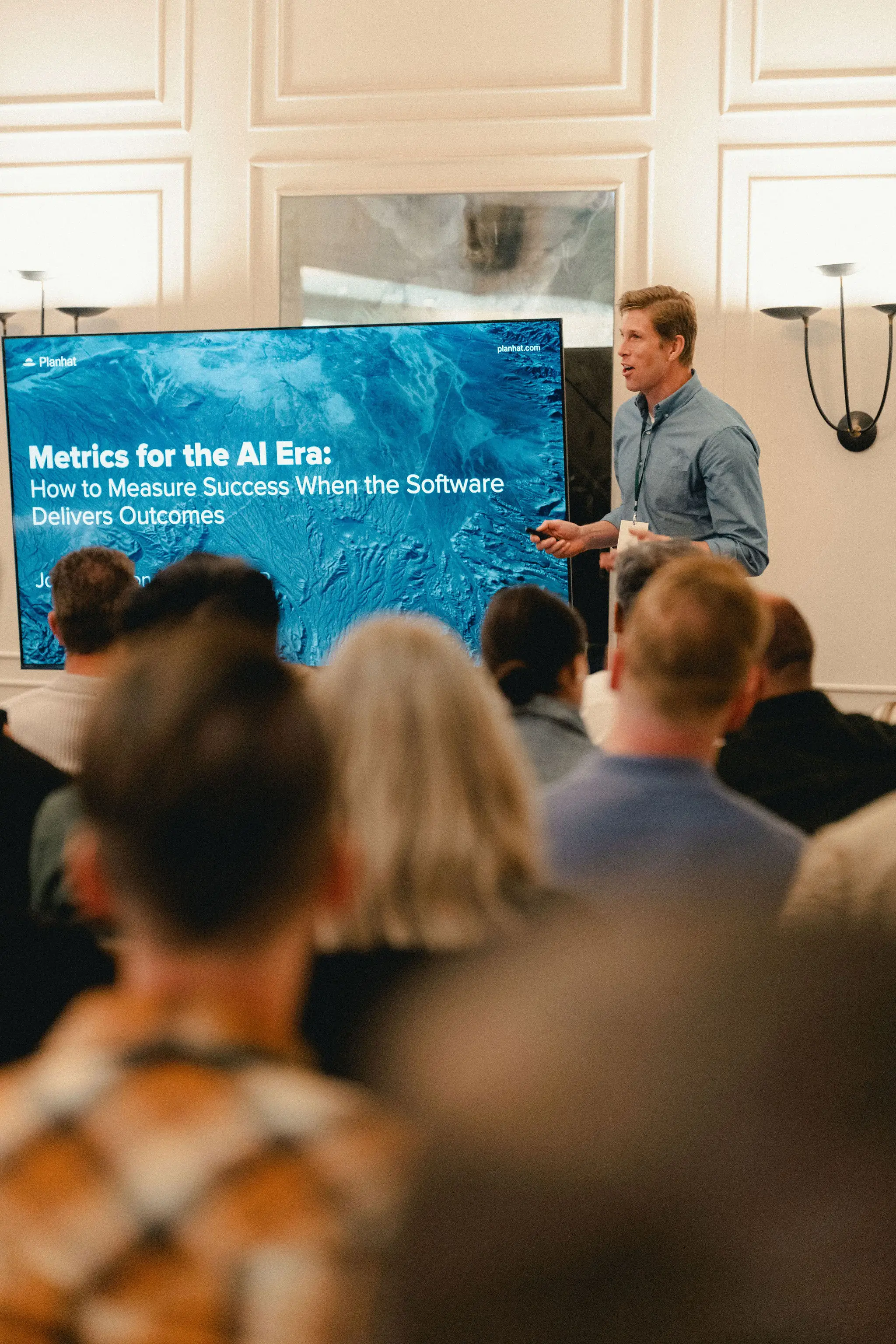
This article is based on a talk given at Planhat Open 2026. Certain sections have been modified for editorial clarity.
Three guiding principles
For organisations considering this restructure, the following three guidelines are helpful:
Someone has to own the number.
Shared accountability often transforms into complete lack of accountability. One person should be looking at the number constantly and driving toward it, rather than a collection of different people.
Leadership must stop protecting territory.
Senior leaders hesitate at unification because it can feel like they are dissolving team boundaries and losing the model that they have worked hard to build. The only way through this is to elevate the leadership group into a shared growth transformation plan and reward collaboration rather than functional wins. If senior leaders are still incentivised on protecting their territory, the structure below them will reflect that.
There needs to be a shared platform
If functions operate in different software, they will see different data and make different assumptions. The tooling decision is downstream of the structural one, but until it is resolved, the cultural change will have nothing to ground itself in.
The familiar structure of separate customer success and marketing functions feels comfortable because we are accustomed to it. While it can produce satisfactory results, it cannot produce the operating outcomes and customer experience that follow from genuine unification.
This article is based on a talk given at Planhat Open 2026. Certain sections have been modified for editorial clarity.
Three guiding principles
For organisations considering this restructure, the following three guidelines are helpful:
Someone has to own the number.
Shared accountability often transforms into complete lack of accountability. One person should be looking at the number constantly and driving toward it, rather than a collection of different people.
Leadership must stop protecting territory.
Senior leaders hesitate at unification because it can feel like they are dissolving team boundaries and losing the model that they have worked hard to build. The only way through this is to elevate the leadership group into a shared growth transformation plan and reward collaboration rather than functional wins. If senior leaders are still incentivised on protecting their territory, the structure below them will reflect that.
There needs to be a shared platform
If functions operate in different software, they will see different data and make different assumptions. The tooling decision is downstream of the structural one, but until it is resolved, the cultural change will have nothing to ground itself in.
The familiar structure of separate customer success and marketing functions feels comfortable because we are accustomed to it. While it can produce satisfactory results, it cannot produce the operating outcomes and customer experience that follow from genuine unification.
This article is based on a talk given at Planhat Open 2026. Certain sections have been modified for editorial clarity.
Expert Advice
Discover best practices from veterans of industry.
[
Discover All
]
[
Through the Lens
]
[
Talking Planhat
]
[
Expert Advice
]
[
In Perspective
]
[
In Conversation
]





Load more
Expert Advice
Discover best practices from veterans of industry.
[
Discover All
]
[
Through the Lens
]
[
Talking Planhat
]
[
Expert Advice
]
[
In Perspective
]
[
In Conversation
]
Load more
Expert Advice
Discover best practices from veterans of industry.
[
Discover All
]
[
Through the Lens
]
[
Talking Planhat
]
[
Expert Advice
]
[
In Perspective
]
[
In Conversation
]
Load more

Don't miss a beat.
Don't miss a beat.