Discover how the Planhat platform—applied to Customer Success—empowers you to deliver more value, to more customers, faster than ever.
Share
Planhat for customer success: a product built to be fast, intuitive and powerful, designed to help your clients achieve their outcomes.
Signing in as a CSM, this may be my landing page, an overview of my book of business, key insights like portfolio health distribution, more specific insights, an overview of all my upcoming tasks to organise my week. Now, zooming out and opening the navigation, this entire CSM day-to-day section was purpose-built for me. All of the views, dashboards, account lists that I care about at my fingertips the very first time I sign in.
“Now, zooming out and opening the navigation, this entire CSM day-to-day section was purpose-built for me. ”
Planhat for customer success: a product built to be fast, intuitive and powerful, designed to help your clients achieve their outcomes.
Signing in as a CSM, this may be my landing page, an overview of my book of business, key insights like portfolio health distribution, more specific insights, an overview of all my upcoming tasks to organise my week. Now, zooming out and opening the navigation, this entire CSM day-to-day section was purpose-built for me. All of the views, dashboards, account lists that I care about at my fingertips the very first time I sign in.
“Now, zooming out and opening the navigation, this entire CSM day-to-day section was purpose-built for me. ”
Planhat for customer success: a product built to be fast, intuitive and powerful, designed to help your clients achieve their outcomes.
Signing in as a CSM, this may be my landing page, an overview of my book of business, key insights like portfolio health distribution, more specific insights, an overview of all my upcoming tasks to organise my week. Now, zooming out and opening the navigation, this entire CSM day-to-day section was purpose-built for me. All of the views, dashboards, account lists that I care about at my fingertips the very first time I sign in.
“Now, zooming out and opening the navigation, this entire CSM day-to-day section was purpose-built for me. ”
A logical place to start my day might be the ‘My Inbox’ view. This is a consolidated view of all the communication happening across my company with my customers, be it a support ticket, an in-app chat, an email communication sent for marketing, sales or professional services. As I drill in, I can see we're automatically using AI to categorise the sentiment of all this customer communication — again, be it call recordings, support ticket chats etc.
If there's ever a negative interaction with a key stakeholders on one of my accounts, I can be notified straight away. But more importantly, zooming out, I can see the trends across all communication we're having with my customers. If conversations are generally trending positive, that can increase the account health score. But if they're trending negative from one period to the next, that can decrease the account health score and trigger all sorts of risk playbooks.
Scrolling down, I can see all the communications nicely and neatly threaded. But if it's a lengthy exchange like this, I’ll leverage AI to get a quick summary of the email exchange. I can also tag colleagues and make sure others are aware by dropping in comments and making sure they're in the loop on key customer communication.
“If I'm responsible for hundreds of accounts, I can't forecast with accuracy. But Planhat can with AI.”
A logical place to start my day might be the ‘My Inbox’ view. This is a consolidated view of all the communication happening across my company with my customers, be it a support ticket, an in-app chat, an email communication sent for marketing, sales or professional services. As I drill in, I can see we're automatically using AI to categorise the sentiment of all this customer communication — again, be it call recordings, support ticket chats etc.
If there's ever a negative interaction with a key stakeholders on one of my accounts, I can be notified straight away. But more importantly, zooming out, I can see the trends across all communication we're having with my customers. If conversations are generally trending positive, that can increase the account health score. But if they're trending negative from one period to the next, that can decrease the account health score and trigger all sorts of risk playbooks.
Scrolling down, I can see all the communications nicely and neatly threaded. But if it's a lengthy exchange like this, I’ll leverage AI to get a quick summary of the email exchange. I can also tag colleagues and make sure others are aware by dropping in comments and making sure they're in the loop on key customer communication.
“If I'm responsible for hundreds of accounts, I can't forecast with accuracy. But Planhat can with AI.”
A logical place to start my day might be the ‘My Inbox’ view. This is a consolidated view of all the communication happening across my company with my customers, be it a support ticket, an in-app chat, an email communication sent for marketing, sales or professional services. As I drill in, I can see we're automatically using AI to categorise the sentiment of all this customer communication — again, be it call recordings, support ticket chats etc.
If there's ever a negative interaction with a key stakeholders on one of my accounts, I can be notified straight away. But more importantly, zooming out, I can see the trends across all communication we're having with my customers. If conversations are generally trending positive, that can increase the account health score. But if they're trending negative from one period to the next, that can decrease the account health score and trigger all sorts of risk playbooks.
Scrolling down, I can see all the communications nicely and neatly threaded. But if it's a lengthy exchange like this, I’ll leverage AI to get a quick summary of the email exchange. I can also tag colleagues and make sure others are aware by dropping in comments and making sure they're in the loop on key customer communication.
“If I'm responsible for hundreds of accounts, I can't forecast with accuracy. But Planhat can with AI.”
Jumping out of here as a CS leader, I'd have access to this section. It can be restricted and only shared with certain people within the business. I can see lagging indicators like a revenue dashboard or year intake, gross retention and net retention figures. But oftentimes in customer success, what we really care about is the future. I think about leading indicators. I could see things like portfolio health across an entire segment or across our entire business. I can see things like product adoption, customer objective achievement, survey results — all in a single location.
Finally, I've got a purpose built section for digital CS. If I were on that team, when I sign in, this section would be pinned to my view and it's giving me everything that I need to know, starting with our strategy for the scaled segment. A dashboard, all the accounts within the segment, all the journeys we have running. If I want to see a specific journey, I can drill in and see it. Just as importantly, I've got the ability to measure the impact of these journeys. I want to understand if all the time and energy that I'm spending on designing them and the content that goes into it is actually having the desired effect — are customers who have gone through it adopting our product more than those who have not?
Finally in a one-to-many model human forecasting is oftentimes not realistic. If I'm responsible for hundreds of accounts, I can't forecast with accuracy. But Planhat can with AI. We've already consolidated all customer communication and product adoption insights. And we can lean into this to understand: what's the forecast? Why is it forecast what it's forecast? And AI can even go ahead and assign the relevant playbook depending on the forecast. So I can see in this case it's assigned a churn risk playbook for this specific opportunity tied to the customer account.
“AI has actually gone out and done additional research bringing in external data to Planhat. ”
Jumping out of here as a CS leader, I'd have access to this section. It can be restricted and only shared with certain people within the business. I can see lagging indicators like a revenue dashboard or year intake, gross retention and net retention figures. But oftentimes in customer success, what we really care about is the future. I think about leading indicators. I could see things like portfolio health across an entire segment or across our entire business. I can see things like product adoption, customer objective achievement, survey results — all in a single location.
Finally, I've got a purpose built section for digital CS. If I were on that team, when I sign in, this section would be pinned to my view and it's giving me everything that I need to know, starting with our strategy for the scaled segment. A dashboard, all the accounts within the segment, all the journeys we have running. If I want to see a specific journey, I can drill in and see it. Just as importantly, I've got the ability to measure the impact of these journeys. I want to understand if all the time and energy that I'm spending on designing them and the content that goes into it is actually having the desired effect — are customers who have gone through it adopting our product more than those who have not?
Finally in a one-to-many model human forecasting is oftentimes not realistic. If I'm responsible for hundreds of accounts, I can't forecast with accuracy. But Planhat can with AI. We've already consolidated all customer communication and product adoption insights. And we can lean into this to understand: what's the forecast? Why is it forecast what it's forecast? And AI can even go ahead and assign the relevant playbook depending on the forecast. So I can see in this case it's assigned a churn risk playbook for this specific opportunity tied to the customer account.
“AI has actually gone out and done additional research bringing in external data to Planhat. ”
Jumping out of here as a CS leader, I'd have access to this section. It can be restricted and only shared with certain people within the business. I can see lagging indicators like a revenue dashboard or year intake, gross retention and net retention figures. But oftentimes in customer success, what we really care about is the future. I think about leading indicators. I could see things like portfolio health across an entire segment or across our entire business. I can see things like product adoption, customer objective achievement, survey results — all in a single location.
Finally, I've got a purpose built section for digital CS. If I were on that team, when I sign in, this section would be pinned to my view and it's giving me everything that I need to know, starting with our strategy for the scaled segment. A dashboard, all the accounts within the segment, all the journeys we have running. If I want to see a specific journey, I can drill in and see it. Just as importantly, I've got the ability to measure the impact of these journeys. I want to understand if all the time and energy that I'm spending on designing them and the content that goes into it is actually having the desired effect — are customers who have gone through it adopting our product more than those who have not?
Finally in a one-to-many model human forecasting is oftentimes not realistic. If I'm responsible for hundreds of accounts, I can't forecast with accuracy. But Planhat can with AI. We've already consolidated all customer communication and product adoption insights. And we can lean into this to understand: what's the forecast? Why is it forecast what it's forecast? And AI can even go ahead and assign the relevant playbook depending on the forecast. So I can see in this case it's assigned a churn risk playbook for this specific opportunity tied to the customer account.
“AI has actually gone out and done additional research bringing in external data to Planhat. ”
Finally, another really practical application of AI for a scaled segment is contact enrichment. This is a key reason for churn at any company: stakeholder turnover. And one of the things that Planhat can do is we create contacts, be it from your CRM, data warehouse, our calendar and email integration, or contacts that are actually added to your product. We can leverage AI to go out and research them. In this case, David's the CEO. Because he's in the C-suite, it's assigned him as a level one contact. It's actually gone out and done additional research bringing in external data to Planhat.
And it can even go a step further, and draft an email based on everything it knows about him externally, coupled with all the information we already have within Planhat. I can then get a notification; an email is awaiting my approval for David. It's already drafted again based on external and internal information. And all I need to do as the CSM when I get notified is come and approve it.
Now jumping to an account view. As I dive in here, I can see everything in a single location. All customer communication, product usage data, and all associated objects, revenue invoices, all here. As a CSM, prior to our customer call, I could run an AI automation and leverage external data in an LLM to go out and research the business: tell me everything I need to know about the customer. Have they been in the news recently? Any financial reporting or advancements or industry hot topics that I've got some talk tracks when I get on with the customer? I can also measure customer objectives. So I can document what those look like. As I click into one, I can see key fields associated with this objective. And rather than asking CSMs to come in and manually update these fields, I can lean into AI workflows to do this based on all call transcripts and email communication. I could come in here and automatically update the health of said objective, whether or not the customer has verified it.
All of that can be done with AI. I've even got a success plan tied to this specific outcome. As you look in here, you could say I've already completed the first three steps in the plan, but the subsequent three steps in the success plan require the customer. I've chosen to share them in the portal. This is a collaborative microsite between me and the customer because I want to align with the customer on these; I want to drive shared accountability. Now, these success plans can also be rolled up into something like a QBR presentation. This is an example of something that you build once, and then you can apply to all accounts in that segment. And it'll automatically bring in the customer's business objectives. It'll automatically populate with that account's data.
If I then wanted to share this with the customer, I could do so in the customer portal. So as I jump into the customer portal, you can see here I've got this collaborative microsite where I'm showing them their QBR presentation always up to date with their data. Or I could upload versions of this. You're seeing the success plan and the steps that I chose to share with the customer. I can communicate on the success plan with the customer here. I could tag them in. I could upload files and we could work together to achieve these outcomes, assigning tasks to the customer, including descriptions and relevant content that they might need to achieve said tasks.
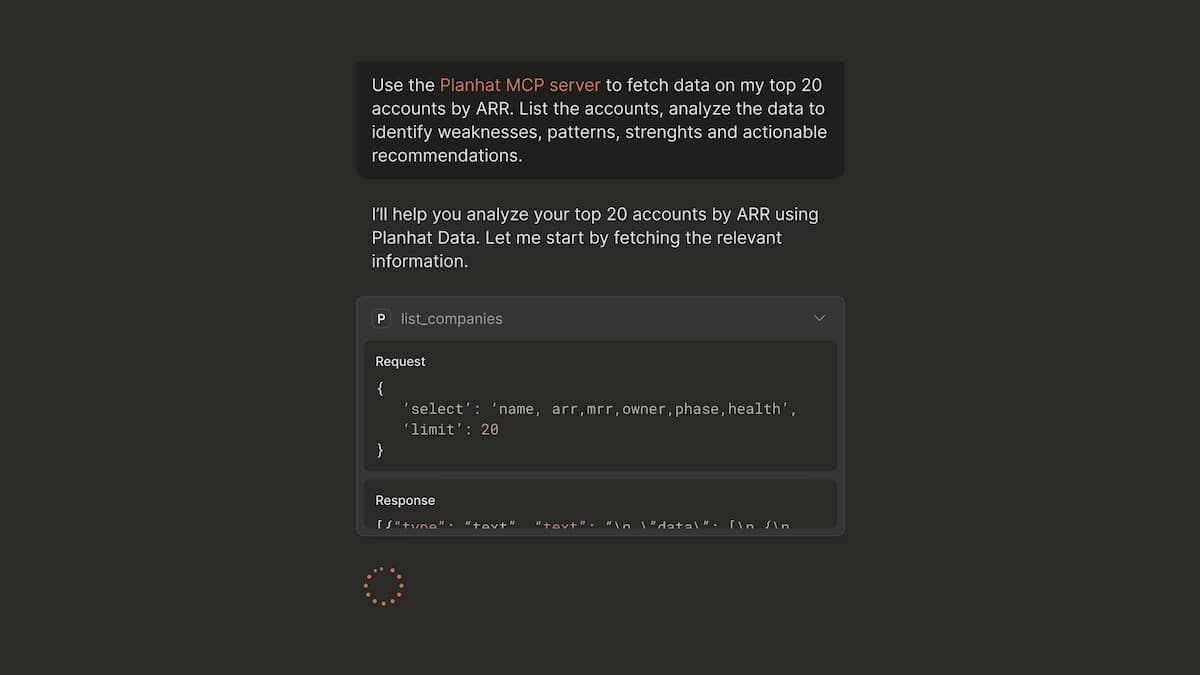
I can also share things like their usage data, their open support tickets. It's a place for me to create transparency, drive towards outcomes with the customer. Finally, as a customer success leader, I may decide to interact with Planhat via Claude. Last year we released our MCP server. And I can do things like create a new chat, ask anything of my customer data in Planhat. What are my top five most at risk renewals next quarter? Leveraging all the data that we have in Planhat, it will return a result and it allows you to get on with your day once you've got the information that you're looking for.
Finally, another really practical application of AI for a scaled segment is contact enrichment. This is a key reason for churn at any company: stakeholder turnover. And one of the things that Planhat can do is we create contacts, be it from your CRM, data warehouse, our calendar and email integration, or contacts that are actually added to your product. We can leverage AI to go out and research them. In this case, David's the CEO. Because he's in the C-suite, it's assigned him as a level one contact. It's actually gone out and done additional research bringing in external data to Planhat.
And it can even go a step further, and draft an email based on everything it knows about him externally, coupled with all the information we already have within Planhat. I can then get a notification; an email is awaiting my approval for David. It's already drafted again based on external and internal information. And all I need to do as the CSM when I get notified is come and approve it.
Now jumping to an account view. As I dive in here, I can see everything in a single location. All customer communication, product usage data, and all associated objects, revenue invoices, all here. As a CSM, prior to our customer call, I could run an AI automation and leverage external data in an LLM to go out and research the business: tell me everything I need to know about the customer. Have they been in the news recently? Any financial reporting or advancements or industry hot topics that I've got some talk tracks when I get on with the customer? I can also measure customer objectives. So I can document what those look like. As I click into one, I can see key fields associated with this objective. And rather than asking CSMs to come in and manually update these fields, I can lean into AI workflows to do this based on all call transcripts and email communication. I could come in here and automatically update the health of said objective, whether or not the customer has verified it.
All of that can be done with AI. I've even got a success plan tied to this specific outcome. As you look in here, you could say I've already completed the first three steps in the plan, but the subsequent three steps in the success plan require the customer. I've chosen to share them in the portal. This is a collaborative microsite between me and the customer because I want to align with the customer on these; I want to drive shared accountability. Now, these success plans can also be rolled up into something like a QBR presentation. This is an example of something that you build once, and then you can apply to all accounts in that segment. And it'll automatically bring in the customer's business objectives. It'll automatically populate with that account's data.
If I then wanted to share this with the customer, I could do so in the customer portal. So as I jump into the customer portal, you can see here I've got this collaborative microsite where I'm showing them their QBR presentation always up to date with their data. Or I could upload versions of this. You're seeing the success plan and the steps that I chose to share with the customer. I can communicate on the success plan with the customer here. I could tag them in. I could upload files and we could work together to achieve these outcomes, assigning tasks to the customer, including descriptions and relevant content that they might need to achieve said tasks.
I can also share things like their usage data, their open support tickets. It's a place for me to create transparency, drive towards outcomes with the customer. Finally, as a customer success leader, I may decide to interact with Planhat via Claude. Last year we released our MCP server. And I can do things like create a new chat, ask anything of my customer data in Planhat. What are my top five most at risk renewals next quarter? Leveraging all the data that we have in Planhat, it will return a result and it allows you to get on with your day once you've got the information that you're looking for.
Thomas Smeallie
VP Commercial Americas
Planhat
Thomas leads Planhat's regional go-to-market strategy and revenue growth across the U.S. He brings over 15 years of experience scaling high-performing sales organizations in SaaS and media technology. Prior to Planhat, Thomas spent more than a decade at Meltwater, rising from Sales Consultant to Senior Area Director, opening new offices, leading teams of 50+ across new business and customer success, and managing over $20M in revenue. His career reflects consistent progression, operational rigor, and a track record of building teams that deliver sustained commercial impact.
Features
Features
The Planhat Platform


MCP Server Demonstration
Discover how Planhat's MCP Server empowers you to go from insight to action faster and more intelligently than ever.
MCP Server Demonstration
Discover how Planhat's MCP Server empowers you to go from insight to action faster and more intelligently than ever.
MCP Server Demonstration
Discover how Planhat's MCP Server empowers you to go from insight to action faster and more intelligently than ever.