Commercial Functions are Collapsing
Commercial Functions are Collapsing

Kaveh Rostampor explores why AI is bringing sales, customer success, support and services together around one commercial brain.
Share
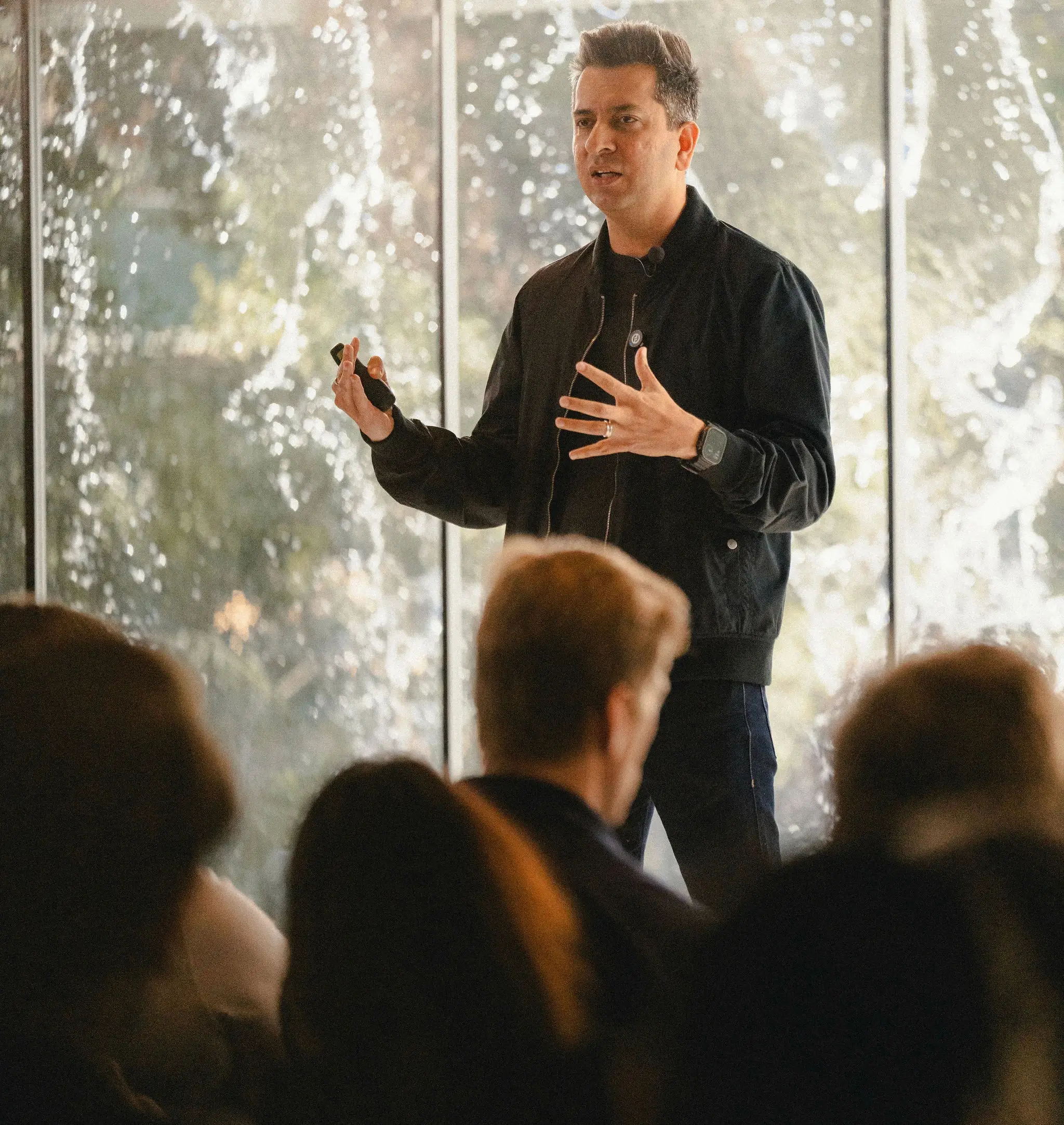
Based on a Keynote at FRONTIER by Planhat, on 10 November 2026.
For more than a decade, we’ve been told that enterprise software will consolidate. Companies have too many tools, too many vendors and too many applications performing overlapping functions. Yet the average enterprise had roughly 80 applications in 2020, compared with around 118 in recent figures.
Why hasn’t software consolidation happened, and what will finally bring it about?
The answer lies in how companies are organized. We’ve spent decades building software around individual departments, each with its own responsibilities, workflows and systems. As AI takes on more commercial work, the constraints that made these divisions necessary are disappearing.
Sales, customer success, support and services are converging. The same technology that allows companies to automate work across these departments is also changing what they need from the people who run them.
Sales, customer success, support and services are converging.”
“
Based on a Keynote at FRONTIER by Planhat, on 10 November 2026.
For more than a decade, we’ve been told that enterprise software will consolidate. Companies have too many tools, too many vendors and too many applications performing overlapping functions. Yet the average enterprise had roughly 80 applications in 2020, compared with around 118 in recent figures.
Why hasn’t software consolidation happened, and what will finally bring it about?
The answer lies in how companies are organized. We’ve spent decades building software around individual departments, each with its own responsibilities, workflows and systems. As AI takes on more commercial work, the constraints that made these divisions necessary are disappearing.
Sales, customer success, support and services are converging. The same technology that allows companies to automate work across these departments is also changing what they need from the people who run them.
“Sales, customer success, support and services are converging.”
Software is inheriting org charts
Look at how a typical company is organized. There’s a sales department, a support department, a customer success department and a services department. Each has its own responsibilities, workflows and management structure, and historically, software has followed those boundaries. Sales has its CRM, support has its ticketing system and customer success has its own platform. Each product is designed to optimize the work of a particular function.
The first generation of AI applications is following exactly the same pattern. We now have sales AI agents, customer success agents, support agents, data enrichment agents and countless others. Every department is acquiring its own collection of specialized AI tools, reproducing the same organizational fragmentation with a different technology.
As long as commercial departments remain separate, the software supporting them will continue to reflect those divisions. Consolidation therefore requires a change in how the underlying work is organized.
Think like a commercial leader rather than someone responsible for one particular department.”
“
Software is inheriting org charts
Look at how a typical company is organized. There’s a sales department, a support department, a customer success department and a services department. Each has its own responsibilities, workflows and management structure, and historically, software has followed those boundaries. Sales has its CRM, support has its ticketing system and customer success has its own platform. Each product is designed to optimize the work of a particular function.
The first generation of AI applications is following exactly the same pattern. We now have sales AI agents, customer success agents, support agents, data enrichment agents and countless others. Every department is acquiring its own collection of specialized AI tools, reproducing the same organizational fragmentation with a different technology.
As long as commercial departments remain separate, the software supporting them will continue to reflect those divisions. Consolidation therefore requires a change in how the underlying work is organized.
“Think like a commercial leader rather than someone responsible for one particular department.”
Why do commercial functions exist in the first place?
We created specialized departments because people have limitations.
People can only manage so much information and perform so many different tasks. They forget things, require management and have a limited number of working hours. Specialization allows organizations to distribute responsibilities among people who develop expertise in a particular area.
Consider a salesperson. You research prospective customers, retrieve relevant information, apply knowledge about your product and the customer’s needs, communicate with the prospect and take action. If you work in support, you follow much the same process. A ticket arrives, you investigate the issue, consult your knowledge of the product and customer, communicate a resolution and take the necessary action.
The channels and immediate objectives differ, but the fundamental activities are much the same: research, context, communication and execution. We’ve built separate departments around work that shares many of the same underlying requirements.
Now imagine starting a company today, with all the technology that’s available. Would you design the same departments, with the same boundaries and handoffs?
AI changes many of the constraints that made specialization necessary. With appropriate access to information and the right systems, agents can operate across different workflows, retain relevant context and execute tasks continuously. They can perform work across multiple functions without requiring separate teams for every process.
Your customer doesn't care about your go-to-market functions
Customers have never cared about the internal departments of the companies they buy from. They see one company on the other side of the relationship, and they expect that company to understand them, remember previous conversations and act accordingly.
Yet anyone who’s worked in customer success will recognize the complaint: “I already told somebody that.”
A customer explains their problem to a business development representative, then repeats it to an account executive. They go through the same information with the implementation team, then with customer success. Eventually, someone arrives to discuss a renewal and asks questions that have already been answered several times.
Businesses have spent years talking about customer-centricity and trying to coordinate their departments around the customer. But the organizational structure makes that difficult because each team maintains part of the relationship and part of the information needed to understand it. Knowledge has to be transferred between systems and people, and those transfers are rarely perfect.
AI creates an opportunity to eliminate these handoffs by making customer context available across commercial workflows. But deploying separate agents within the same departmental boundaries preserves the fragmentation that causes the problem.
Five agentic islands are still five islands
An AI agent needs much the same information as a human employee to perform its job properly. It needs to understand the customer, the company’s products, the history of the relationship and what’s happening across the customer lifecycle.
Sales understands why the customer bought the product and what expectations were established. Services understands the implementation and its difficulties. Customer success understands usage, value and relationship risk, while support knows the customer’s technical issues and request history.
When an AI agent has access to only one part of that information, its decisions are constrained by the same departmental boundaries as the people it supports.
Consider an AI support agent. It may have access to the customer’s ticket history, the help center and the product documentation. Given that information, it can produce a convincing answer to a support question. But it may have no idea what the salesperson promised during the buying process, what went wrong during implementation or what the customer is ultimately trying to achieve. Without that context, the agent can confidently recommend the wrong solution.
Each agent is being optimized for a particular function rather than the full customer relationship. Consequently, deploying more agents within isolated departments can make fragmentation worse, even as individual teams become more efficient.
One commercial brain across the customer lifecycle
At Planhat, our vision is that most commercial work will eventually be automated or agentic in nature. Today, the majority of business processes are still human-led, with automation supporting particular tasks. That balance will shift as agents become capable of executing more complete workflows.
Our vision is built around one commercial brain.
That brain contains the context, memory and best practices needed to understand the customer and the business across the entire customer lifecycle.
On top of this shared foundation, different agents execute different jobs. Because they have access to the same underlying customer context, their work can be coordinated across functions. A support interaction can be understood in the context of an implementation project, while an expansion opportunity can be evaluated against the customer’s objectives, product usage and relationship history.
This architecture also changes the role of people within the organization. As agents execute more workflows, humans take greater responsibility for directing and governing those processes.
We call these people commercial operators.
Commercial operators oversee processes, exercise judgment, manage exceptions and ensure that work is executed against the right commercial objectives. Their responsibility extends across the customer lifecycle because the systems they govern operate across functions.
How to stay relevant as commercial functions consolidate
Over the next two to five years, three capabilities will become particularly valuable: understanding customers deeply, using technology to increase your output and developing knowledge of the business beyond your immediate function.
1. Understand your customer better than anyone else
Get to know the people you work with. Understand what they’re trying to accomplish inside their companies, which KPIs they’re responsible for, what difficulties they face and what matters to them personally and professionally. Take your customer to lunch. Spend time with them outside the usual sequence of Zoom meetings and emails, and build a relationship that gives you a deeper understanding of their circumstances.
Most companies have a long tail of smaller accounts and a smaller number of strategically important customers. The long tail should increasingly be managed through automated systems, while larger or more complex relationships receive greater human attention. Trying to deliver the same level of personal service to every customer consumes resources without accounting for the different needs and value of those relationships.
You need to bring something to the table that the software systems cannot. Knowing the customer exceptionally well is one of the strongest ways to do that.
2. Get leverage in the work you do
Across commercial functions, individual contributors and leaders can use agents and workflows to execute repeatable tasks, increasing the amount of work they manage without spending more time on manual execution.
Start by asking yourself a simple question: If you could build 10 workflows or agents to do work for you, what would they do?
Automated meeting notes are a useful starting point, but you need to move beyond that. Think about the entire customer lifecycle and identify the work that consumes your time. Examine the signals available at different stages, the decisions those signals should inform and the actions that follow.
To build more sophisticated workflows, break the work into its component parts. Identify the signals, dependencies and decisions involved, then determine which activities agents can execute and where human judgment remains necessary. The more thoroughly you understand a process, the more effectively you can automate it.
3. Learn the business, not only your function
If you work in customer success, you should understand how your sales team sells. Why do customers buy your product? What’s the value proposition? Which competitors do you encounter, and why do customers choose you over them?
Likewise, if you work in sales, you should understand what happens after the contract is signed. What makes an implementation successful? Why do some customers struggle to adopt the product? What causes customers to churn, and what distinguishes the accounts that achieve the greatest value?
These questions reveal how the different parts of your business contribute to the customer experience. They also expose the dependencies between commercial activities, which you’ll need to understand when designing workflows that operate across functional boundaries.
Think like a commercial leader rather than someone responsible for one particular department.
As more commercial work becomes automated, the ability to formulate the right instructions will be increasingly valuable. To instruct an agent effectively, you need to understand what you’re asking it to accomplish, why the outcome matters and how it relates to other activities within the business.
The rise of the commercial operator
Who will become the commercial operators responsible for this work?
Today’s VPs and senior executives already have broad responsibility and visibility across the business, making them natural candidates. But people from sales, customer success, services and support can also move into these roles by developing the necessary knowledge, technical capabilities and judgment.
The pressure to do more with fewer resources will intensify as AI makes higher levels of productivity achievable. Commercial functions will consolidate around shared customer context and automated execution, and the people who understand the customer, know the business and can command the technology will be positioned to lead them.
The Archive
[
Discover All
]
[
Through the Lens
]
[
Talking Planhat
]
[
Expert Advice
]
[
In Perspective
]
[
In Conversation
]





Load more
The Archive
[
Discover All
]
[
Through the Lens
]
[
Talking Planhat
]
[
Expert Advice
]
[
In Perspective
]
[
In Conversation
]
Load more
The Archive
[
Discover All
]
[
Through the Lens
]
[
Talking Planhat
]
[
Expert Advice
]
[
In Perspective
]
[
In Conversation
]
Load more

Don't miss a beat.
Don't miss a beat.