The Story of Pi
The Story of Pi
Pi is the world’s first multiplayer customer agent. This is the story of how it came to be.
Share
The first intelligence curves
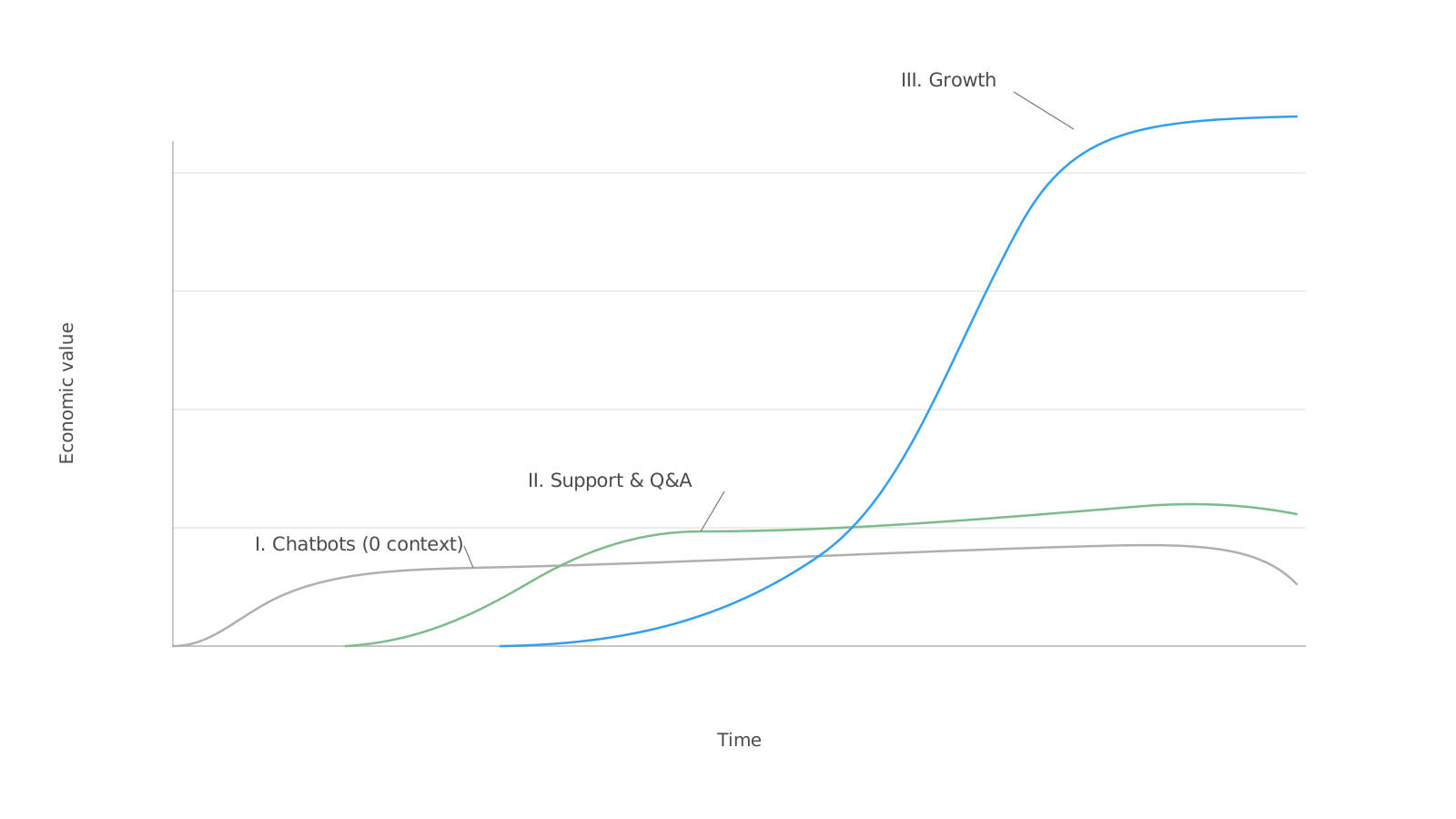
In the beginning, LLMs had no context — chatbots that were fun but useless in the enterprise.
With reasoning capabilities and RAG, they became more capable. This created the first commercial AI products that actually worked — Fin by Intercom, Sierra, Glean. They automated support tickets or answered internal questions. This second intelligence curve was the first that paid off, allowing companies to be more efficient in their customer support operations.
At Planhat, we were obviously front-row to this evolution — but it was clear that customer success platforms, and CRMs in the broader sense, were not yet on the intelligence curve in any meaningful way. Sales, success and service teams were still doing the work, and still typing it in afterwards.
The defining trait of this second intelligence curve, which allowed for this kind of isolated automation, was that its context was clear, often high-quality, and direct. The work was short-horizon and conversational. Verifiability was instant. If someone said "thank you for resolving the problem", you succeeded. In essence: a perfect environment for LLMs.

The first intelligence curves
In the beginning, LLMs had no context — chatbots that were fun but useless in the enterprise.
With reasoning capabilities and RAG, they became more capable. This created the first commercial AI products that actually worked — Fin by Intercom, Sierra, Glean. They automated support tickets or answered internal questions. This second intelligence curve was the first that paid off, allowing companies to be more efficient in their customer support operations.
At Planhat, we were obviously front-row to this evolution — but it was clear that customer success platforms, and CRMs in the broader sense, were not yet on the intelligence curve in any meaningful way. Sales, success and service teams were still doing the work, and still typing it in afterwards.
The defining trait of this second intelligence curve, which allowed for this kind of isolated automation, was that its context was clear, often high-quality, and direct. The work was short-horizon and conversational. Verifiability was instant. If someone said "thank you for resolving the problem", you succeeded. In essence: a perfect environment for LLMs.
The first intelligence curves
In the beginning, LLMs had no context — chatbots that were fun but useless in the enterprise.
With reasoning capabilities and RAG, they became more capable. This created the first commercial AI products that actually worked — Fin by Intercom, Sierra, Glean. They automated support tickets or answered internal questions. This second intelligence curve was the first that paid off, allowing companies to be more efficient in their customer support operations.
At Planhat, we were obviously front-row to this evolution — but it was clear that customer success platforms, and CRMs in the broader sense, were not yet on the intelligence curve in any meaningful way. Sales, success and service teams were still doing the work, and still typing it in afterwards.
The defining trait of this second intelligence curve, which allowed for this kind of isolated automation, was that its context was clear, often high-quality, and direct. The work was short-horizon and conversational. Verifiability was instant. If someone said "thank you for resolving the problem", you succeeded. In essence: a perfect environment for LLMs.
Enterprise complexity
The problem for us was that customer management is one of the most ambiguous and complex environments in the enterprise. Fuzzy and low-quality context, multi-dimensional objectives, long horizons of work, unclear attribution and poor verifiability. Renewing a customer who pays you $100k a year is not a support question. It's understanding their problems and the many ways you could solve them. It's the interpersonal dynamics of enterprise sales, and fine-grained commercial acumen. And then it's orchestrating all of that into outcomes your customers love.
Think of the best sales or service person you know. You can't prompt for that.
So we stayed out of the game, patiently waiting. In 2025, we brought out the v1 of our AI platform to give our customers ability to start automating the simple — and 90% of our customers automated at least 1 process with AI within the first 5 months. Over 2026 the AI usage has grown by 15x.
But that change was still isolated more than transformative.
Enterprise complexity
The problem for us was that customer management is one of the most ambiguous and complex environments in the enterprise. Fuzzy and low-quality context, multi-dimensional objectives, long horizons of work, unclear attribution and poor verifiability. Renewing a customer who pays you $100k a year is not a support question. It's understanding their problems and the many ways you could solve them. It's the interpersonal dynamics of enterprise sales, and fine-grained commercial acumen. And then it's orchestrating all of that into outcomes your customers love.
Think of the best sales or service person you know. You can't prompt for that.
So we stayed out of the game, patiently waiting. In 2025, we brought out the v1 of our AI platform to give our customers ability to start automating the simple — and 90% of our customers automated at least 1 process with AI within the first 5 months. Over 2026 the AI usage has grown by 15x.
But that change was still isolated more than transformative.
Enterprise complexity
The problem for us was that customer management is one of the most ambiguous and complex environments in the enterprise. Fuzzy and low-quality context, multi-dimensional objectives, long horizons of work, unclear attribution and poor verifiability. Renewing a customer who pays you $100k a year is not a support question. It's understanding their problems and the many ways you could solve them. It's the interpersonal dynamics of enterprise sales, and fine-grained commercial acumen. And then it's orchestrating all of that into outcomes your customers love.
Think of the best sales or service person you know. You can't prompt for that.
So we stayed out of the game, patiently waiting. In 2025, we brought out the v1 of our AI platform to give our customers ability to start automating the simple — and 90% of our customers automated at least 1 process with AI within the first 5 months. Over 2026 the AI usage has grown by 15x.
But that change was still isolated more than transformative.
Acceleration
The Claude Code / Opus 4.5 moment of early 2026 was the defining moment for us. The raw intelligence was there. The question became how to make it useful in one of the hardest environments in business.
Complex B2B commercial work is fundamentally different. It is open-ended, multi-objective and multi-stakeholder. Data is incomplete. Incentives conflict. Negotiation matters. Decisions unfold across days, quarters and years. There is rarely one correct next action. If you have ever carried a quota, you know this is a tough arena. Your agents need to understand that too.
That starts with memory. Pi builds a living commercial memory of every customer: what happened, what changed, what was promised, what worked and what matters now. Long term history and current state live together, so work compounds rather than restarting with every conversation.
Around that sits a harness built for commercial context. In coding, you can often test whether the answer works. Commercial work has no equivalent unit test. The quality of the decision depends on seeing the full picture, right down to the details — holding multiple hypotheses in your head at the same time. Pi continuously assembles the right context, reasons over it, scenario-tests it. It uses the tools your teams already depend on, and carries state across long horizon workflows. With this context, renewal is not an email. It is a sequence of product signals, conversations, commitments, risks and actions that can stretch across years.
Then comes governance and orchestration. Pi knows what it can see, what it can do, and when a person should be involved. Because Planhat is also where teams work together on customer data, agent workflows can live inside human workflows. Pi can route decisions, request approval, bring in the right person and continue from there, with permissions and traceability throughout.
Claude Code and Codex take frontier models and turn them into systems purpose built for coding. Pi does the same for long-horizon commercial work. It sits on top of the strongest model composition available, or the models an enterprise chooses to bring, and adds the memory, harness, tools, workflows and governance this environment requires.
This makes Pi the first agent built to show up for every customer with the context, continuity and judgment your best person brings to their most important account, every day, for years.
Acceleration
The Claude Code / Opus 4.5 moment of early 2026 was the defining moment for us. The raw intelligence was there. The question became how to make it useful in one of the hardest environments in business.
Complex B2B commercial work is fundamentally different. It is open-ended, multi-objective and multi-stakeholder. Data is incomplete. Incentives conflict. Negotiation matters. Decisions unfold across days, quarters and years. There is rarely one correct next action. If you have ever carried a quota, you know this is a tough arena. Your agents need to understand that too.
That starts with memory. Pi builds a living commercial memory of every customer: what happened, what changed, what was promised, what worked and what matters now. Long term history and current state live together, so work compounds rather than restarting with every conversation.
Around that sits a harness built for commercial context. In coding, you can often test whether the answer works. Commercial work has no equivalent unit test. The quality of the decision depends on seeing the full picture, right down to the details — holding multiple hypotheses in your head at the same time. Pi continuously assembles the right context, reasons over it, scenario-tests it. It uses the tools your teams already depend on, and carries state across long horizon workflows. With this context, renewal is not an email. It is a sequence of product signals, conversations, commitments, risks and actions that can stretch across years.
Then comes governance and orchestration. Pi knows what it can see, what it can do, and when a person should be involved. Because Planhat is also where teams work together on customer data, agent workflows can live inside human workflows. Pi can route decisions, request approval, bring in the right person and continue from there, with permissions and traceability throughout.
Claude Code and Codex take frontier models and turn them into systems purpose built for coding. Pi does the same for long-horizon commercial work. It sits on top of the strongest model composition available, or the models an enterprise chooses to bring, and adds the memory, harness, tools, workflows and governance this environment requires.
This makes Pi the first agent built to show up for every customer with the context, continuity and judgment your best person brings to their most important account, every day, for years.
Acceleration
The Claude Code / Opus 4.5 moment of early 2026 was the defining moment for us. The raw intelligence was there. The question became how to make it useful in one of the hardest environments in business.
Complex B2B commercial work is fundamentally different. It is open-ended, multi-objective and multi-stakeholder. Data is incomplete. Incentives conflict. Negotiation matters. Decisions unfold across days, quarters and years. There is rarely one correct next action. If you have ever carried a quota, you know this is a tough arena. Your agents need to understand that too.
That starts with memory. Pi builds a living commercial memory of every customer: what happened, what changed, what was promised, what worked and what matters now. Long term history and current state live together, so work compounds rather than restarting with every conversation.
Around that sits a harness built for commercial context. In coding, you can often test whether the answer works. Commercial work has no equivalent unit test. The quality of the decision depends on seeing the full picture, right down to the details — holding multiple hypotheses in your head at the same time. Pi continuously assembles the right context, reasons over it, scenario-tests it. It uses the tools your teams already depend on, and carries state across long horizon workflows. With this context, renewal is not an email. It is a sequence of product signals, conversations, commitments, risks and actions that can stretch across years.
Then comes governance and orchestration. Pi knows what it can see, what it can do, and when a person should be involved. Because Planhat is also where teams work together on customer data, agent workflows can live inside human workflows. Pi can route decisions, request approval, bring in the right person and continue from there, with permissions and traceability throughout.
Claude Code and Codex take frontier models and turn them into systems purpose built for coding. Pi does the same for long-horizon commercial work. It sits on top of the strongest model composition available, or the models an enterprise chooses to bring, and adds the memory, harness, tools, workflows and governance this environment requires.
This makes Pi the first agent built to show up for every customer with the context, continuity and judgment your best person brings to their most important account, every day, for years.
Becoming Pi
Pi takes on a few roles in your organisation.
First, Pi watches the business continuously. It learns from customer emails, calls, tickets, product usage, funding events, and other commercial signals. It surfaces risk and opportunity proactively, saves down memories, keeps data clean, and organises the context your team needs before an important decision or customer conversation. Think of your most thoughtful account manager reading everything and writing down what matters.
Second, Pi helps people get work done. Directly, in Sessions, or indirectly, through MCP and API, it can prepare meetings, triage inboxes, draft replies, log notes, update data, submit timesheets, analyse churn, plan a quarter, recommend what to do next, and then do it. The baseline is no longer finding information. It is completing useful work. Think of your best sales rep as an assistant to the whole team, available all the time.
Third, Pi can own entire processes. It can run renewals for the long tail, manage the administration around a complex onboarding, or help a freemium prospect understand the product and buy. Soon it can configure and implement your product autonomously. That can free significant capacity, which companies can reinvest in growth and in people working directly with customers to turn promises into outcomes.
This next era is not one of "doing less". It's doing more, better.
Becoming Pi
Pi takes on a few roles in your organisation.
First, Pi watches the business continuously. It learns from customer emails, calls, tickets, product usage, funding events, and other commercial signals. It surfaces risk and opportunity proactively, saves down memories, keeps data clean, and organises the context your team needs before an important decision or customer conversation. Think of your most thoughtful account manager reading everything and writing down what matters.
Second, Pi helps people get work done. Directly, in Sessions, or indirectly, through MCP and API, it can prepare meetings, triage inboxes, draft replies, log notes, update data, submit timesheets, analyse churn, plan a quarter, recommend what to do next, and then do it. The baseline is no longer finding information. It is completing useful work. Think of your best sales rep as an assistant to the whole team, available all the time.
Third, Pi can own entire processes. It can run renewals for the long tail, manage the administration around a complex onboarding, or help a freemium prospect understand the product and buy. Soon it can configure and implement your product autonomously. That can free significant capacity, which companies can reinvest in growth and in people working directly with customers to turn promises into outcomes.
This next era is not one of "doing less". It's doing more, better.
Becoming Pi
Pi takes on a few roles in your organisation.
First, Pi watches the business continuously. It learns from customer emails, calls, tickets, product usage, funding events, and other commercial signals. It surfaces risk and opportunity proactively, saves down memories, keeps data clean, and organises the context your team needs before an important decision or customer conversation. Think of your most thoughtful account manager reading everything and writing down what matters.
Second, Pi helps people get work done. Directly, in Sessions, or indirectly, through MCP and API, it can prepare meetings, triage inboxes, draft replies, log notes, update data, submit timesheets, analyse churn, plan a quarter, recommend what to do next, and then do it. The baseline is no longer finding information. It is completing useful work. Think of your best sales rep as an assistant to the whole team, available all the time.
Third, Pi can own entire processes. It can run renewals for the long tail, manage the administration around a complex onboarding, or help a freemium prospect understand the product and buy. Soon it can configure and implement your product autonomously. That can free significant capacity, which companies can reinvest in growth and in people working directly with customers to turn promises into outcomes.
This next era is not one of "doing less". It's doing more, better.
Entering the third intelligence curve
Pi is live with a first group of customers, and we're customer zero. A few weeks in, 30% of the human admin work across our own long tail has moved to Pi, and it has cleaned up several data sources we didn't know had even gone bad.
All customers in early access have consolidated workflows from Claude and other tools into Planhat OS and Pi, because it's just better. It brings harmony to work and cuts iteration cycles by orders of magnitude.
Pi feels like the third intelligence curve. Like all things worth doing, it won't be easy. But we think Pi, and the the OS we've built around it, represents a huge leap in ability for our customers to win in the next era.
Entering the third intelligence curve
Pi is live with a first group of customers, and we're customer zero. A few weeks in, 30% of the human admin work across our own long tail has moved to Pi, and it has cleaned up several data sources we didn't know had even gone bad.
All customers in early access have consolidated workflows from Claude and other tools into Planhat OS and Pi, because it's just better. It brings harmony to work and cuts iteration cycles by orders of magnitude.
Pi feels like the third intelligence curve. Like all things worth doing, it won't be easy. But we think Pi, and the the OS we've built around it, represents a huge leap in ability for our customers to win in the next era.
Entering the third intelligence curve
Pi is live with a first group of customers, and we're customer zero. A few weeks in, 30% of the human admin work across our own long tail has moved to Pi, and it has cleaned up several data sources we didn't know had even gone bad.
All customers in early access have consolidated workflows from Claude and other tools into Planhat OS and Pi, because it's just better. It brings harmony to work and cuts iteration cycles by orders of magnitude.
Pi feels like the third intelligence curve. Like all things worth doing, it won't be easy. But we think Pi, and the the OS we've built around it, represents a huge leap in ability for our customers to win in the next era.
Why Pi?
Our CTO Niklas ended up naming the agent Pi for a few reasons.
First, it's a neat acronym for Planhat Intelligence. But more than that, Pi — the mathematical symbol that has intrigued people for millennia — represented exactly the kind of complexity, irregularity, and ever-changing nature that we think commercial work consists of. If you've managed a million-dollar portfolio, woken up every day with a quota, or tried to deliver projects on-time and on-budget — you know that the only constant is that things will change. Yet you keep searching for patterns, for playbooks, for structure — much like people still search for the structures of Pi.
It felt fitting.
Why Pi?
Our CTO Niklas ended up naming the agent Pi for a few reasons.
First, it's a neat acronym for Planhat Intelligence. But more than that, Pi — the mathematical symbol that has intrigued people for millennia — represented exactly the kind of complexity, irregularity, and ever-changing nature that we think commercial work consists of. If you've managed a million-dollar portfolio, woken up every day with a quota, or tried to deliver projects on-time and on-budget — you know that the only constant is that things will change. Yet you keep searching for patterns, for playbooks, for structure — much like people still search for the structures of Pi.
It felt fitting.
Why Pi?
Our CTO Niklas ended up naming the agent Pi for a few reasons.
First, it's a neat acronym for Planhat Intelligence. But more than that, Pi — the mathematical symbol that has intrigued people for millennia — represented exactly the kind of complexity, irregularity, and ever-changing nature that we think commercial work consists of. If you've managed a million-dollar portfolio, woken up every day with a quota, or tried to deliver projects on-time and on-budget — you know that the only constant is that things will change. Yet you keep searching for patterns, for playbooks, for structure — much like people still search for the structures of Pi.
It felt fitting.
Talking Planhat
We are the sum of the stories told about us.
[
Discover All
]
[
In Focus
]
[
Through the Lens
]
[
Talking Planhat
]
[
Expert Advice
]
[
In Perspective
]
[
In Conversation
]
Load more
Talking Planhat
We are the sum of the stories told about us.
[
Discover All
]
[
In Focus
]
[
Through the Lens
]
[
Talking Planhat
]
[
Expert Advice
]
[
In Perspective
]
[
In Conversation
]
Load more
Talking Planhat
We are the sum of the stories told about us.
[
Discover All
]
[
In Focus
]
[
Through the Lens
]
[
Talking Planhat
]
[
Expert Advice
]
[
In Perspective
]
[
In Conversation
]
Load more

Don't miss a beat.
Don't miss a beat.